Alternative Business Financing: 12 Options Beyond Banks
Most business owners still pick up the phone and call their bank first when they need capital. Traditional banks approve a small fraction of small business loan applications (according to Federal Reserve Small Business Credit Survey data, denial rates remain high across most loan categories), and by the time a bank says no, weeks have passed, the opportunity has moved on, and the business is in a worse position than when it started. Alternative business financing exists precisely because that pattern keeps repeating.
Alternative business financing is any structured funding that exists outside a conventional bank loan or SBA program. This includes advances against future revenue, factoring of receivables, fintech-issued term loans, direct commercial lending, real estate bridge products, and community-driven capital sources. The category is broader than most operators realize, and the right fit depends entirely on your situation, not on which option sounds most familiar.
This guide covers 12 specific options. For each one, you’ll find a plain-language explanation of how it works, what it actually costs, how fast you can get funded, and which business situations it genuinely fits. The market now runs from $10,000 microloan programs to multi-million-dollar working capital deals through direct commercial funders, which makes comparison more important than ever.
What alternative business financing is and why it exists
The gap that banks created
Banks underwrite based on credit history, collateral, time-in-business thresholds, and debt service coverage ratios. These criteria work well for established businesses with solid tax return histories and hard assets to pledge. For most growing businesses, they’re disqualifying by design. A restaurant generating $2M in annual revenue but operating for 14 months doesn’t fit the model, not because the business is weak, but because the bank’s underwriting framework isn’t built to evaluate it.
Conservative underwriting timelines make the problem worse. Bank loan decisions can take several weeks in typical commercial situations, and in complex cases may run longer still. Deal caps mean even qualified borrowers often can’t get the amount they actually need. When an acquisition needs to close in two weeks or a seasonal inventory buy can’t wait for Q3 paperwork to clear, the bank loan is functionally off the table regardless of creditworthiness.
How the alternative lending market evolved
The alternative lending market grew directly out of the gap banks created. Hard-money real estate lenders were among the earliest non-bank capital sources, evaluating deals on asset value rather than borrower profile. That model expanded into merchant cash advances in the early 2000s, then grew rapidly with fintech platforms after 2010 when cloud-based underwriting and open banking data made revenue-based decisions possible at scale.
Today’s market includes direct funders, fintech platforms, P2P lending networks, asset-based lenders, equipment specialists, CDFIs, and crowdfunding platforms. Each uses a fundamentally different underwriting model, but they share one core premise: business performance and cash flow tell a more accurate story than a credit score alone.
Who uses alternative financing most
The businesses that rely most heavily on alternative business financing are not struggling operators looking for a last resort. They’re established businesses that need speed over rate, growing companies with strong revenue but inconsistent credit history, and real estate operators who need bridge capital before a competitive acquisition closes. Industries that banks underwrite conservatively, including hospitality, trucking, construction, and healthcare, also rely disproportionately on alternative sources because traditional lenders apply blanket restrictions regardless of individual business performance.
How alternative business financing differs from traditional banks
The approval criteria are fundamentally different
Bank loan approval typically requires a strong credit score, collateral that covers the loan amount, multiple years of tax returns, demonstrated DSCR ratios, and ongoing loan covenants that restrict business decisions post-funding. That’s a high bar, and it’s designed to protect the bank’s balance sheet, not to serve the business’s growth needs. Thresholds vary by lender and loan type, so specific credit score cutoffs depend on the institution and product in question.
Alternative lenders evaluate recent bank statements, revenue trends, and business performance. Decisions happen in hours, not weeks. This shift from asset-based to revenue-based underwriting is the defining difference between the two models, and it’s why businesses with strong cash flow but imperfect credit histories can access substantial capital through alternative channels while being turned away by institutions.
Speed versus cost: the real trade-off
Bank loans generally offer lower APRs and longer repayment terms for borrowers who qualify. The problem is getting to that favorable structure: the approval process takes weeks to months, and any complexity in the file can extend that timeline significantly. Alternative financing carries higher effective costs, but capital arrives in 24 hours to 3 business days in most cases.
This is a legitimate business decision, not a desperation move. Speed has real dollar value. When you’re closing an acquisition, covering payroll during a receivables gap, or capturing a time-limited inventory deal, the cost of waiting 45 days for a bank answer is often higher than the premium charged by a faster lender. Experienced operators understand this math.
When the trade-off makes sense
Alternative business financing makes clear economic sense in specific situations: time-sensitive opportunities where delay kills the deal; bank-declined files where the business has strong revenue but weak credit history or short operating history; and situations where a fixed monthly payment structure would create cash flow stress that daily or weekly revenue-linked repayments would not. The framing matters. This isn’t about accepting second-best. It’s about choosing the right tool for the situation at hand.
1. Merchant cash advances
How merchant cash advances work
A merchant cash advance provides a lump sum of capital in exchange for a percentage of future credit card receipts or bank deposits. Repayment happens automatically through daily or weekly deductions, a fixed percentage of your incoming revenue until the full amount is paid back. There’s no fixed monthly payment and no amortization schedule; the repayment moves with your sales volume.
Pricing uses a factor rate rather than an APR. A 1.3 factor rate on a $100,000 advance means you repay $130,000 total. The effective APR depends entirely on how fast you repay: that same 1.3 factor repaid over 6 months works out to approximately 60% effective APR, while the same advance repaid over 12 months drops to a materially lower effective rate. The factor rate looks simple, but the effective cost varies significantly based on repayment speed.
Which businesses fit the MCA model
Merchant cash advances work best for retail operations, restaurants, e-commerce businesses, and service companies with consistent credit card volume or predictable bank deposits. The automatic repayment mechanism aligns with businesses that have steady daily revenue, since deductions are small and continuous rather than large and periodic. Factor rates typically range from 1.1 to 1.5, and most advances fund in 24 to 48 hours from application approval. Repayment terms average 3 to 12 months depending on advance size and repayment rate.
2. Revenue-based financing
How revenue-based financing works
Revenue-based financing is structurally similar to an MCA but applied to gross monthly revenue rather than credit card receipts specifically. An investor or lender provides upfront capital, which is repaid as a fixed percentage of gross monthly revenue until a predetermined multiplier, typically 1.2 to 1.5 times the funded amount, is fully paid back. Payments shrink in slow months and increase in strong ones, which means repayment aligns with your actual business performance rather than a fixed schedule.
This structure suits SaaS companies, subscription businesses, and e-commerce brands with predictable but variable revenue. There’s no fixed end date; the repayment timeline is entirely a function of how your revenue performs. Origination fees are typically low, ranging from 0 to 3%, and effective APR varies significantly based on how quickly the business grows and repays. Most revenue-based deals fund within 48 to 72 hours once underwriting is complete.
3. Invoice factoring
Invoice factoring: selling receivables for immediate cash
Invoice factoring involves selling your unpaid customer invoices to a third-party factoring company at a discount. The factor advances you 70 to 90% of the invoice face value immediately, then collects payment directly from your customer when the invoice comes due. Once collected, the factor releases the remaining balance minus their fee. The critical distinction is that the factor takes over collections from your customers, which affects the B2B relationship dynamic.
Fees run approximately 2 to 5% per 30 days the invoice remains outstanding, structured on a factor rate basis. If your customer pays in 30 days, your cost is relatively contained. If they pay at 90 days, those fees compound into a significantly higher effective cost. Funding typically happens same-day to 48 hours once the factoring relationship is established and invoices are verified.
Invoice financing: keeping control of collections
Invoice financing uses your receivables as collateral for a line of credit rather than selling them outright. You still collect from your customers directly, which preserves the relationship dynamic. The lender advances funds against your outstanding invoices, and you repay as collections come in. This approach requires strong accounts receivable management on your end but gives you more control over the customer experience.
Both products are well-suited for B2B service companies, staffing agencies, logistics firms, and contractors operating on 30 to 90-day payment cycles. The primary underwriting factor isn’t your credit score; it’s the creditworthiness of your customers. A business with weak personal credit but Fortune 500 clients can often factor receivables at favorable rates because the risk profile of the underlying invoices is what matters.
4. Bridge loans and large working capital advances
What bridge financing is and who needs it
A bridge loan is short-term capital that covers the gap between an immediate need and longer-term financing. In real estate, it’s the funding that lets an investor acquire a property before permanent financing closes, complete a value-add rehab, or capitalize on a competitive acquisition where timing eliminates the option of waiting for a conventional loan. Bridge loans use LTV-driven underwriting, meaning the asset’s value and the deal structure matter more than the borrower’s personal credit profile.
For real estate operators and developers, bridge financing is often the only viable path when deals move faster than traditional lenders can respond. Underwriting evaluates the property, the exit strategy, the borrower’s track record with similar assets, and the overall deal structure. Terms typically run 6 to 24 months, bridging into a permanent loan or a sale.
Large working capital advances: above the bank ceiling
Most operators assume working capital financing tops out at amounts banks are comfortable lending, and that assumption leaves large, established businesses dramatically underserved. Direct commercial funders operate at a scale that most business owners don’t realize exists within the alternative financing space. Greenvest Funding, for example, works on working capital advances well into the seven-figure range with rapid decision turnarounds designed for high-revenue businesses that need capital at scale and speed.
For companies generating strong monthly deposits that have been turned away by institutional lenders because of deal caps, credit nuances, or industry classifications, direct commercial funders offer a genuinely different path. That’s not a bank timeline with alternative underwriting layered on top; it’s a fundamentally different operational model built for businesses the bank can’t serve efficiently.
The underwriting difference in large-ticket deals
Traditional banks apply the same conservative ratio-based underwriting regardless of deal size. A $2M working capital request goes through the same DSCR analysis, collateral review, and covenant structure as a $200,000 loan, except the scrutiny is more intense and the timeline is longer. Direct funders evaluate revenue consistency, bank deposit history, business performance trends, asset quality, and deal structure. Files that banks cap or decline outright get approved at this level because the underwriting framework is built for a different risk model.
For established businesses and real estate operators, this is where alternative financing stops being a fallback and becomes the deliberate first call. When your deal needs to close this week and the file is large enough that institutional lenders would take 60 days to say no, a direct funder with real underwriting capacity is the right partner from the start.
5. Online term loans and business lines of credit
Online term loans: structured repayment without the bank timeline
Online term loans provide a fixed loan amount with a fixed repayment schedule and APR-based pricing. Effective APR ranges widely, from 10% on the competitive end to 99% for higher-risk profiles, with most alternative online lenders averaging 25 to 50% APR for established borrowers. Origination fees typically run 1 to 6% of the loan amount, and terms average 3 to 24 months with fixed monthly payments.
Approval timelines range from 24 hours to 3 business days, with no collateral required in many programs. This product suits businesses that need a defined capital amount with a predictable repayment structure, particularly those that can’t manage the daily or weekly deduction model of an MCA. The trade-off versus an MCA is that the APR-based structure is more transparent but requires consistent monthly cash flow to service the fixed payment.
Business lines of credit through fintech platforms
A fintech-issued business line of credit gives you a revolving credit facility: draw what you need, pay interest only on what you’ve drawn, and repay to restore availability. APR ranges from 7 to 60%, averaging 10 to 30% for borrowers with solid revenue and established bank history. Origination fees run 0 to 4%, often waived for strong borrowers.
This product is the best fit for businesses with cyclical cash flow gaps who need flexible, repeatable access to capital rather than a single lump-sum advance. A construction company managing multiple project cycles, a seasonal retailer bridging inventory buys, or a staffing firm covering payroll between client payments will all find more utility in a revolving line than in a fixed-term advance. Fintech platforms disrupted this segment with automated underwriting built on bank data integrations and revenue algorithms, dramatically accelerating approval timelines versus traditional bank processes.
6. Equipment financing
Equipment financing: letting the asset pay for itself
Equipment financing uses the specific piece of equipment being purchased as collateral for the loan. The asset secures the debt, which generally means more favorable rates than unsecured products and less reliance on broader business creditworthiness. APR varies from 7 to 35% depending on asset type, lender, and credit profile. Specialty online equipment lenders approve faster than banks, and SBA 504 programs offer low down payments for qualifying businesses with longer repayment terms of up to 84 months.
This product is purpose-built for asset-heavy industries: manufacturing, construction, trucking, food service, and any operation where a specific piece of equipment directly drives revenue. The underwriting logic is straightforward, if the business stops paying, the lender takes the equipment. That secured structure allows lenders to approve deals they wouldn’t approve on a cash flow basis alone, and it allows businesses to preserve working capital for operations rather than tying it up in equipment purchases.
7. Peer-to-peer business loans
P2P lending: individual and institutional capital combined
Peer-to-peer business lending platforms connect businesses directly with individual or institutional investors who fund loans in exchange for interest returns. The platform handles matching, underwriting, servicing, and payment processing. For the borrower, the experience resembles an online loan application; the capital source is just different from a traditional bank or direct funder.
P2P lending works best for established businesses with clean track records and a clear narrative around how funds will be deployed. Rates vary significantly based on credit profile and platform, ranging from 7 to 50% APR. Some platforms allow investors to review the business and ask questions during the funding process, which creates a community dimension that pure lending products don’t offer. This product category is less suited for businesses needing same-day capital; approval and funding timelines are typically longer than MCA or direct funder options.
8. Crowdfunding and CDFIs
Crowdfunding: community capital for the right business model
Rewards-based crowdfunding on platforms like Kickstarter and Indiegogo works best for product businesses needing pre-launch capital. Backers receive a product, experience, or recognition in exchange for pledging funds. There’s no debt and no equity dilution, but success requires a compelling campaign and substantial marketing effort. It’s a funding mechanism that doubles as a market validation exercise, which is the real value proposition for early-stage product businesses.
Equity crowdfunding is a different product entirely. Investors receive ownership stakes in the business in exchange for capital, which means the business must be structured to offer and track equity. This approach suits scalable businesses with a clear growth story and tolerance for diluted ownership. Neither crowdfunding model is appropriate for businesses needing capital quickly; campaigns take weeks to build momentum and close.
CDFIs: mission-driven capital for underserved businesses
Community Development Financial Institutions are mission-driven lenders offering micro-loans and small business financing, typically under $50,000, to businesses that traditional lenders underserve. This includes women-owned, minority-owned, and rural businesses, as well as operators in low-income communities. CDFIs often use community-funded structures and apply more flexible underwriting criteria than banks or most fintech lenders.
Rates for CDFI loans are typically among the most favorable in the alternative space, ranging from 5 to 18% APR, because the mission is economic development rather than profit maximization. These are not speed products; the application and approval process is thorough and community-oriented. But for businesses that qualify and need smaller amounts, CDFIs offer capital access with terms that few other alternative lenders can match at that size.
What these 12 options actually cost: a direct comparison
Factor rates versus APR: why the comparison matters
Most alternative financing products don’t quote APR. Merchant cash advances, invoice factoring, and revenue-based financing use factor rates, and understanding the difference is critical before you sign anything. A 1.3 factor rate does not mean 30% APR. It means you repay 1.3 times the funded amount, regardless of how long it takes. The effective APR is entirely a function of repayment speed. A 1.3 factor advance repaid over 6 months translates to approximately 60% effective APR, repaid over 12 months, the effective rate is considerably lower. This distinction is often buried in the fine print of factor-rate products, and failing to understand it leads to significant cost miscalculations.
Cost and term reference across all 12 options
| Financing Type | Typical Pricing | Origination Fees | Average Term | ||||
|---|---|---|---|---|---|---|---|
| Merchant cash advance | Factor 1.1 to 1.5 (eff. APR 30 to 100%+) | Built into factor | 3 to 12 months | ||||
| Revenue-based financing | Factor 1.2 to 1.5 (variable effective APR) | 0 to 3% | 6 to 18 months | ||||
| Invoice factoring | 2 to 5% per 30 days | 0 to 1% | 30 to 90 days | Invoice financing | APR 10 to 40% (revolving) | 0 to 2% | Revolving |
| Bridge loans | Varies by LTV and deal structure | 1 to 3% | 6 to 24 months | ||||
| Large working capital advances | Factor 1.1 to 1.45 (deal-specific) | Deal-dependent | 6 to 24 months | ||||
| Online term loans | APR 10 to 99% (avg. 25 to 50%) | 1 to 6% | 3 to 24 months | ||||
| Business lines of credit | APR 7 to 60% (avg. 10 to 30%) | 0 to 4% | Revolving | ||||
| Equipment financing | APR 7 to 35% | 0 to 2% | 24 to 84 months | ||||
| P2P business loans | APR 7 to 50% | 1 to 5% | Variable | ||||
| Crowdfunding (rewards) | Platform fee 5 to 8% of raise | None | Campaign-based | ||||
| CDFI micro-loans | APR 5 to 18% | Minimal | Micro-loan terms |
The hidden costs that aren’t in the factor rate
Beyond the stated factor rate or APR, several costs can materially change the total repayment obligation. UCC (Uniform Commercial Code) filings are standard in most MCA and direct lending agreements; the lender files a lien against your business assets as security. Lockbox arrangements in invoice factoring mean your customers’ payments route through the factor’s account before reaching you, which can complicate banking relationships. Origination fees are often calculated on the gross funded amount, not net proceeds, so a 3% fee on a $500,000 advance is $15,000 off the top before you see a dollar.
Early repayment is another area that catches operators off guard. Unlike traditional loans, most MCA and factor-rate products don’t offer a discount for early payoff. You agreed to repay 1.3x the funded amount, and that’s what you owe whether you pay it in 3 months or 12. Always calculate your total repayment obligation, not just the stated rate, before signing any alternative financing agreement.
Eligibility and documentation: what alternative lenders actually require
Minimum requirements across lender types
Minimum credit score requirements vary more than most operators expect. MCAs will work with scores as low as 500; most fintech term loan products require 600 to 660; invoice factoring largely ignores personal credit altogether because the customer’s creditworthiness drives the approval. Time-in-business requirements range from 6 months minimum for MCA products to 12 to 24 months for most structured term loan programs.
Annual revenue thresholds start around $50,000 for entry-level products and climb to $250,000 or higher for direct funder programs that operate above the $250,000 advance threshold. For larger deals, the conversation shifts away from credit score almost entirely. Revenue consistency, bank deposit history, and deal structure are the underwriting levers that matter at scale. Businesses that have been declined or capped by institutional lenders for reasons unrelated to actual performance are often well-positioned for direct commercial funder approval precisely because the criteria are different.
What to have ready before you apply
The single most important document for most alternative financing applications is your business bank statements, covering 3 to 12 months depending on the product. Lenders use these to verify revenue, assess consistency, identify existing debt obligations, and evaluate the average daily balance patterns that indicate whether the business can service the proposed advance.
Beyond bank statements, most lenders will ask for some combination of the following:
- Recent tax returns (1 to 2 years where required, particularly for fintech term loans and bridge products)
- Proof of receivables or contracts (for invoice factoring and asset-based lending)
- Business financials including income statements or CPA-prepared summaries for larger files
- Property details, purchase agreements, and LTV documentation for bridge loan applications
- Government-issued ID and entity documents (operating agreement or articles of organization)
For bridge loans specifically, lenders typically don’t require personal tax returns, W-2s, debt-to-income verification, or employment records. The focus is on the property, the deal structure, the exit strategy, and the borrower’s track record with similar assets. Self-employed investors and operators with complex income structures often find bridge financing more accessible than traditional lending for exactly this reason.
Common reasons applications stall or get declined
Incomplete documentation is the most preventable cause of application delays. Submitting 4 months of bank statements when 6 are required, or missing a required business license or entity document, creates back-and-forth that adds days to an otherwise straightforward approval. The second most common issue is open tax liens or existing judgments, which most alternative lenders treat as significant red flags regardless of current business performance.
Excessive stacking of existing MCA positions, multiple advances outstanding simultaneously, is a deal-killer for most direct funders. It signals cash flow stress and complicates the repayment math significantly. Industry restrictions also matter; cannabis businesses, firearms dealers, and certain service categories are excluded from many alternative lending programs regardless of performance metrics. Knowing these restrictions before you apply saves time and prevents unnecessary hard inquiries on your business file.
How to choose the right alternative business financing option
The decision framework: four questions to answer first
Before you approach any lender, four questions will eliminate most of the 12 options and point you clearly toward the ones that actually fit your situation.
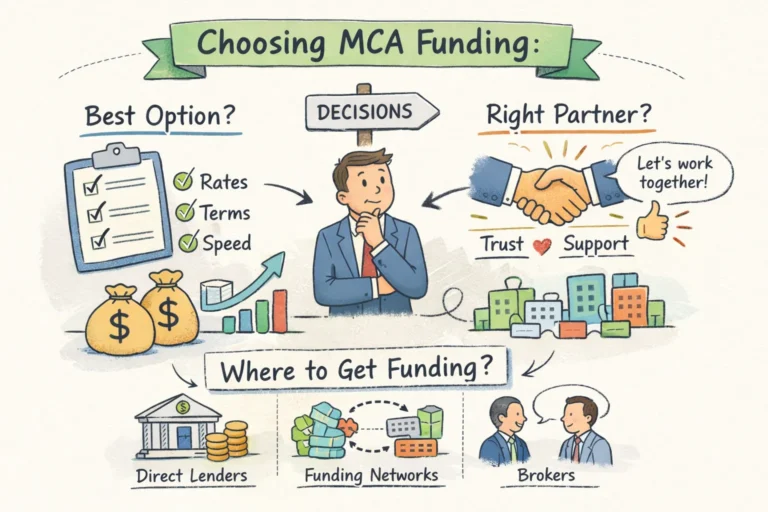
- How fast do you actually need the capital? Same-day or next-day requirements point directly to MCAs and large direct funder programs. Timelines of 3 to 7 days open up fintech term loans and lines of credit. Longer timelines allow for P2P lending, CDFI applications, or equipment financing through specialty lenders.
- What is your primary use of funds? Operations and cash flow gaps favor MCAs, lines of credit, or revenue-based financing. Equipment purchases fit equipment financing. Real estate acquisitions and project capital need bridge lending or large working capital advances. Receivables gaps fit invoice factoring or financing.
- What is your monthly revenue and how consistent is it? Strong, consistent monthly deposits of $100,000 or more open the direct funder and large working capital advance category. Variable or seasonal revenue fits revenue-based financing or a revolving line of credit. Consistent B2B invoices with creditworthy customers fit factoring.
- Are you comfortable with daily or weekly repayments, or do you need a fixed monthly structure? Daily automatic deductions work for high-volume retail and restaurant operations with predictable daily cash flow. Fixed monthly payments suit businesses with predictable monthly net revenue and steady operating expenses.
Answering these four questions honestly eliminates most of the 12 options immediately and leaves you with 2 to 3 viable products to evaluate in detail. That’s the comparison that actually matters.
A short application checklist before you submit
The gap between getting approved and getting declined on a quality file is often just preparation. Submit clean, complete documentation the first time and you dramatically increase approval speed and reduce the likelihood of conditional approvals requiring multiple rounds of back-and-forth.
- Pull 6 to 12 months of business bank statements (all accounts, all pages).
- Check for open tax liens, judgments, or existing MCA positions and be prepared to address them directly.
- Identify your target funding amount and the minimum timeline that works for your situation.
- Determine whether a factor rate structure or APR-based pricing is better for your cash flow model based on repayment timing.
- Match to the right lender tier by deal size: micro-loan programs for $10,000 to $50,000, fintech platforms for $50,000 to $250,000, and direct commercial funders like Greenvest Funding for larger deals above that threshold.
- Submit with complete documentation. Incomplete applications are the leading cause of delays and the most easily avoided.
The deliberate choice that experienced operators make
Alternative business financing is not a fallback for businesses that can’t get bank loans. For speed, scale, and flexibility, it’s the deliberate first choice of experienced operators who understand that the cost of capital isn’t just the rate, it’s the rate plus the cost of delay. A bank loan at a lower APR that takes 60 days to close is not a better deal than a direct advance at a higher rate that funds tomorrow when the deal requires capital this week.
The right funder makes the difference at every level of this market. At the large-deal end, working with a direct funder that has genuine underwriting capacity, fast decision capability, and a demonstrated track record with complex files gives businesses an operational advantage that no traditional lender can replicate on its timeline.
The bottom line on alternative business financing
The 12 options covered in this guide fall into four broad categories: advance-based products (MCAs, revenue-based financing, large working capital advances), receivables-based products (invoice factoring and invoice financing), asset-secured products (bridge loans and equipment financing), and platform-based or community products (fintech term loans, lines of credit, P2P loans, crowdfunding, and CDFIs). Each category has a different cost structure, approval speed, and eligibility profile.
The right alternative business financing choice for your business comes down to your timing, deal size, revenue profile, and tolerance for different repayment structures. There’s no universal best option, only the best fit for your specific situation at this specific moment. Getting that match right is the difference between capital that solves the problem and capital that creates a new one.
If your deal is $100,000 or larger and you need a decision quickly, a direct commercial funder is likely the right call. Greenvest Funding works specifically with established businesses and real estate operators who need real underwriting capacity, fast turnarounds, and capital at scale, on files that institutional lenders routinely cap or decline. If that sounds like your situation, the conversation is worth having.