How to Package a Working Capital Deal for Underwriting
If you’ve ever asked yourself how to package a working capital deal for underwriting and actually get it approved on the first pass, the answer almost never comes down to the merchant’s numbers. Most working capital deals that get declined or stalled aren’t declined because of the merchant. They’re declined because of how the deal was packaged. Underwriters process high volumes of files every day, and they don’t have time to fill in the blanks. If your submission doesn’t tell a complete story from the first page, it goes to the bottom of the pile while the cleaner files get approved.
This matters more than most brokers realize. A weak presentation of a strong merchant consistently loses to a well-packaged deal from an average merchant. The mechanics of underwriting reward brokers who anticipate questions, not just those who gather documents. If you want faster decisions, better offers, and funders who prioritize your submissions, packaging is where that reputation gets built.
This guide covers every layer of a lender-ready working capital submission: the document checklist, how to read bank statements the way underwriters do, revenue trend framing, use-of-funds narratives, net working capital (NWC) metrics, and the packaging mistakes that kill deals before they’re ever reviewed. Work through each section and you’ll have a repeatable system for submitting files that get approved on the first pass.
Why deal packaging determines approval more than the merchant’s numbers
The merchant’s financials are the raw material. The package you build is the product. Underwriters aren’t reading your submission looking for reasons to approve; they’re scanning for reasons to move on. An incomplete file doesn’t get a phone call asking for the missing pieces. It gets set aside while a complete file from another broker gets funded the same day.
Weak packaging creates back-and-forth that adds days or weeks to a decision timeline. Every request for a missing document, an unexplained bank statement anomaly, or a vague use-of-funds statement resets the clock. Brokers who package deals proactively get faster responses, cleaner approvals, and better repeat placement rates because funders know what to expect when a file comes in with their name on it.
The underwriter’s perspective on a new submission
In the first 60 seconds of reviewing a file, an underwriter is doing one thing: determining whether it’s worth their full attention. They’re checking whether the basic documents are present, whether the merchant profile matches the product, and whether anything immediately disqualifies the deal. A missing document, mismatched business name, or a bank statement that’s a screenshot of a printout stops that process cold.
What keeps a file moving forward is completeness and coherence. The underwriter should be able to open the package and immediately understand who the merchant is, what they need, why they need it, and whether the fundamentals support an approval. If they have to search for that context, they’re already less confident in the file.
What “lender-ready” means in the alternative lending context
A lender-ready working capital package isn’t a stack of PDFs dumped into a folder. It’s a coherent story with supporting documentation. The difference between a reactive submission and a proactive one is straightforward: reactive submissions send whatever the merchant provides and hope the underwriter figures it out. Proactive submissions anticipate every question before it’s asked and address it in the package itself.
Lender-ready means the bank statements are clean downloads, the documents match each other, the narrative explains the context behind the numbers, and nothing is left to interpretation. That’s the standard. Everything below builds toward it.
How to package a working capital deal for underwriting: the core document checklist
Every working capital submission needs a non-negotiable baseline. These documents aren’t optional; they’re the foundation the underwriter uses to evaluate the deal. Submitting without any of them doesn’t start a conversation, it creates a stall before the review even begins.
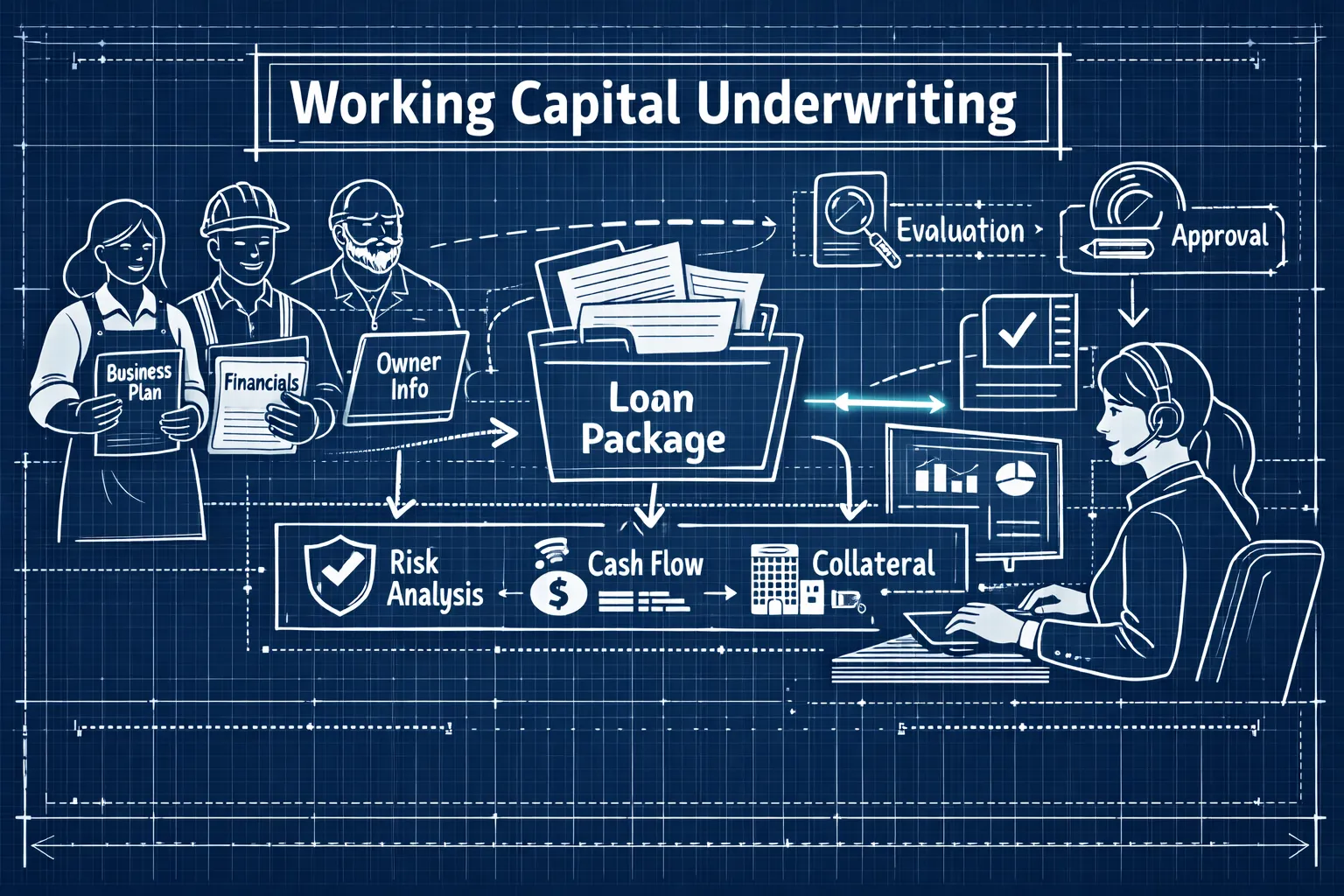
The standard document set for most direct funder and MCA-style working capital deals includes: 3 to 6 months of business bank statements (originals or direct downloads only), 2 years of business tax returns, a current profit and loss statement, business formation documents, voided check, government-issued ID for all owners above a 20% stake, and a complete schedule of existing debts and obligations. For SBA or acquisition-related working capital structures, this expands to include the purchase agreement, business valuation, and a full NWC schedule reconciled to the closing date.
Bank statements and financial records
Bank statements are the core of any working capital underwrite. For MCA and alternative working capital products, 3 months is the minimum threshold most funders use, but submitting 6 months strengthens the file when revenue trends are positive. More data gives underwriters more confidence, provided the trend supports the deal. If the trend is negative, 3 months may be the better play, but be prepared to address the context in your narrative.
The format of bank statements matters. Underwriters require originals or direct downloads from the bank’s online portal. Screenshots, scanned printouts, or photos of paper statements are rejected or flagged for verification. Get the merchant to pull them directly from their banking platform and download the PDFs. That one step eliminates one of the most common friction points in the submission process. For an expanded discussion on best practices for documenting and underwriting working capital disbursements, see best practices for underwriting and documenting working capital disbursements.
Business formation and identity verification
Articles of Incorporation or organization, EIN documentation, and owner ID verification are non-negotiable in every working capital submission. Entity verification confirms the business is legitimately registered, the owner signing the application has authority to do so, and the deal isn’t flagged for compliance review before it even reaches an underwriter’s desk.
Mismatched information between the application and formation documents creates compliance holds that halt the file immediately. If the business operates under a DBA that differs from the legal entity name on the bank account, that needs to be documented and explained. If ownership has changed since formation, include supporting documentation. Don’t leave the underwriter to discover discrepancies independently.
Existing debt and obligation schedules
The debt schedule is one of the most underutilized documents in a working capital package, and its absence is one of the fastest ways to get a deal slowed down. Underwriters need a complete picture of the merchant’s current obligations: existing MCAs, term loans, lines of credit, lease obligations, and any other recurring financial commitments. This isn’t just documentation; it’s the data set used to calculate available cash flow and determine whether the merchant qualifies for a 1st or 2nd position product.
Include the lender name, original balance, current balance, monthly payment, maturity date, and position for each obligation. If the merchant has an active MCA with a remaining balance, that information changes the deal structure. Give the underwriter the full picture upfront. Deals that get declined for undisclosed stacking often had the information available, the broker just didn’t include it.
How to present bank statements the way underwriters actually read them
Before you submit a file, read the bank statements the way the underwriter will. Identify every anomaly, every overdraft, every unusual deposit. If you spot it before submission, you can address it in the narrative. If the underwriter spots it first without context, their interpretation defaults to the most conservative possible read.
Average daily balance and what funders benchmark against
Average daily balance (ADB) is calculated by summing the ending balance for each day in the review period and dividing by the number of days. Most direct funders and MCA companies benchmark ADB against a minimum threshold, typically in the $10,000 range for smaller deals, with $20,000 or higher unlocking better terms and offer sizes. ADB directly affects how much a merchant can be approved for and what factor rate applies.
Submitting 6 months of statements instead of 3 gives underwriters a longer trend line, which can either strengthen or weaken a submission. If revenue has been growing over 6 months, the longer history works in your favor. If ADB has been declining, 3 months of stronger recent data may produce a better outcome. Understand the trend before you decide how much history to submit.
NSFs, overdrafts, and negative balance days
Insufficient fund events (NSFs) and overdrafts are the fastest way to get a deal declined or downgraded. Underwriters count NSF frequency across the bank statement period and compare it against their threshold. A single NSF event in 6 months is usually explainable. Recurring NSFs across multiple months signal cash management problems that make repayment unreliable.
If the merchant has NSF history, address it directly in your submission narrative. Explain the circumstances: a delayed wire, a payroll timing issue, a one-time event that’s been corrected. A brief honest explanation in the package is far stronger than silence. When a broker doesn’t address negative flags, the underwriter assumes they either missed them or are hiding them. Neither interpretation helps the deal.
Deposit consistency and revenue pattern analysis
Deposit frequency and volume consistency tell the story of how a business actually operates. Underwriters look for regular, predictable deposit patterns aligned with the merchant’s stated revenue. Sudden spikes in the final month before submission trigger scrutiny: is the merchant front-loading deposits to inflate the picture? A revenue event that distorts the average needs explanation.
If the spike is legitimate, a large contract payment, a seasonal peak, or a tax refund to the business, document it. Show the underwriter what caused the spike and why it doesn’t represent the ongoing revenue baseline. Transparency here is a strength, not a weakness. Brokers who address anomalies proactively build credibility with underwriters, who start to trust that what they see in a submission is what they get.
Time in business, revenue trends, and how to frame each scenario
Time in business is one of the most significant variables in how a working capital deal gets structured and what’s available to the merchant. Most direct funders tier their programs: under 6 months is a different product set than 6 to 12 months, and 2 or more years opens access to larger facilities and longer terms. Understanding these tiers tells you exactly what the submission needs to prove.
Why time in business affects approval more than credit score
Personal credit score is one input. Time in business is the structure that determines what’s possible. A merchant with excellent credit and 4 months in business will qualify for fewer products and smaller advance amounts than a merchant with average credit and 3 years in business. Early-stage businesses need stronger bank statement support and often more detailed use-of-funds documentation to offset the lack of operating history.
For merchants in the 6 to 18 month window, the bank statements carry the most weight. The underwriter is looking for revenue trends that justify confidence in the business’s staying power. Show them a consistent or growing deposit history, stable ADB, and a clear use of funds, and you’ve made the most compelling case possible within the constraints of the product tier.
Revenue growth vs. revenue contraction: framing each scenario
A growing revenue trend tells its own story. A declining trend requires context, and that context needs to come from the broker, not from the underwriter’s imagination. If monthly deposits have been declining over the past 4 months, the underwriter will not ignore that. They will either decline the file or apply more conservative terms. Your job is to get ahead of that by providing the reason in your narrative.
Acceptable explanations include a lost contract that’s been replaced by a new one, a seasonal contraction that repeats year-over-year, or a temporary market disruption that’s resolved. Unacceptable is silence. A one-paragraph narrative that honestly explains the revenue dip and provides supporting context, a new contract, a recovery trend, a documented seasonal cycle, keeps the deal alive and demonstrates that the broker knows the merchant’s business.
Seasonality documentation and how to address it proactively
Seasonal businesses are common across construction, retail, agriculture, hospitality, and landscaping. Without context, a 40% revenue drop in Q1 looks like business deterioration. With a seasonality narrative and a year-over-year comparison showing the same pattern in previous years, it’s a normal operating cycle. The difference between these two interpretations is whether the broker included the context.
When presenting seasonal businesses, use a trailing 12-month average as your primary revenue reference rather than a single-period snapshot. This is also where the concept of a working capital target peg becomes useful: the normalized baseline of what the business needs to operate through its slow period. Document what working capital the merchant requires to bridge to their peak season and tie the use of funds directly to that operating cycle. That framing makes the deal immediately comprehensible to any underwriter who reviews it.
Writing a use-of-funds narrative that builds underwriter confidence
Most brokers either skip the use-of-funds narrative or write a single generic line. “General working capital” tells the underwriter nothing useful. It signals that either the broker doesn’t know the merchant’s situation well enough to explain it, or the merchant doesn’t have a clear plan for the capital. Both readings undermine confidence in the file.
Why vague use-of-funds statements lose deals
“Business expenses” is not a use-of-funds statement. It’s a placeholder. Underwriters are evaluating whether the capital deployment makes sense for the merchant’s revenue cycle and whether there’s a logical connection between what the money is used for and the merchant’s ability to repay. Vague language breaks that connection entirely.
The level of specificity required scales with deal size. A $150,000 advance to a trucking company needs at least a few sentences explaining what the funds cover. A $750,000 facility for a contractor needs a structured breakdown. For acquisition-related working capital, the use-of-funds needs to connect directly to the operating needs of the acquired business and how the funds support the transition period.
The structure of a compelling use-of-funds summary
A strong use-of-funds summary covers four things: what the capital will be used for in specific categories, why the timing matters to the merchant’s business cycle, how the deployment connects to revenue generation or cost reduction, and how the merchant plans to service the obligation beyond the payment mechanics. This doesn’t need to be a long document, but it needs to be specific enough that an underwriter can picture exactly what happens when the funds hit the merchant’s account.
For larger deals or acquisition-adjacent working capital structures, include a reference to how the funds relate to the normalized operating cycle and the NWC requirement. If the merchant is acquiring a business and needs working capital to maintain operations through the transition, state that explicitly. The underwriter reviewing a $1M+ file wants to see that the use of capital is tied to a real operational plan, not just a number on an application.
NWC metrics and financial ratios funders check before approving
For deals above $250,000, or for any SBA or acquisition-related working capital structure, underwriters go beyond bank statements. They evaluate financial ratios that reflect the merchant’s capacity to sustain operations and service new debt simultaneously. Knowing these metrics before you submit gives you the ability to either present them favorably or address weaknesses proactively.
Current ratio, quick ratio, and what healthy looks like
The current ratio measures short-term liquidity by dividing current assets by current liabilities. Underwriters typically look for a current ratio between 1.2 and 2.0. Below 1.0 means the business has more short-term obligations than assets, which triggers deeper scrutiny or a decline. The quick ratio refines this by removing inventory from current assets, targeting a result at or above 1.0 to confirm liquidity without relying on inventory conversion. For more on the common metrics underwriters use, review this breakdown of common financial ratios used in underwriting.
If the merchant’s ratios are below threshold, don’t ignore them. Address the context in the narrative: recent investment in inventory that’s been deployed, a timing gap between payables and receivables, or a short-term liability that’s already been resolved since the statement date. Underwriters will calculate these ratios themselves; your job is to make sure the story around the numbers is already in the package when they do.
Working capital adequacy, NWC peg, and the lender-ready schedule
Net working capital (NWC) is calculated as operating current assets minus operating current liabilities, excluding cash and financing instruments to focus strictly on operational liquidity. For M&A and acquisition financing contexts, the NWC peg is the negotiated baseline: the normalized level of working capital required to operate the business at its current revenue level. If actual NWC at closing falls below the peg, the seller typically covers the shortfall through a purchase price adjustment. For a clear primer on net working capital calculations, see this net working capital (NWC) primer.
For any deal involving acquisition financing or SBA structures, a lender-ready NWC schedule needs to be reconciled before submission. This means documenting which line items are included in the NWC calculation, the trailing 12-month average used to determine the peg, and the methodology for any post-closing true-up. Leaving this undefined creates disputes and delays; see guidance on working capital adjustments and tips to mitigate M&A disputes for examples of common pitfalls and mitigations. Present it clean and documented, and the underwriter has one less reason to ask for more information.
Debt service coverage and working capital covenants
Debt service coverage ratio (DSCR) measures whether the business generates sufficient net operating income to cover its debt obligations. Underwriters typically look for a minimum DSCR of 1.2 to 1.4x, meaning the business generates $1.20 to $1.40 for every $1.00 of debt service. A DSCR below 1.2x signals that the existing cash flow may not comfortably support a new obligation, especially when combined with existing MCA payments.
For larger facilities and SBA 7(a) structures, working capital covenants may appear in term sheet conditions, requiring the borrower to maintain a minimum current ratio or NWC balance as a condition of the facility. If these covenants are part of the deal structure, they need to be disclosed to the merchant before closing. A broker who understands these conditions and explains them clearly is a broker funders want to work with again.
Common packaging mistakes that stall or kill deals
The most avoidable deal failures come from the same set of recurring errors. These aren’t complex mistakes. They’re gaps that could be fixed in 20 minutes of pre-submission review, but most brokers skip that review because they’re moving fast. Moving fast without reviewing your package costs more time than the review itself would have.
Missing context that forces underwriters to assume the worst
Three situations consistently trigger conservative underwriter interpretations: unexplained gaps in deposit activity, a sudden revenue spike in the final month before submission, and a new entity with minimal operating history but a large capital request. In every case, the underwriter defaults to the most cautious interpretation when no explanation is provided. They assume the gap means cash flow problems, the spike means deposit manipulation, and the new entity means high risk.
Address each of these in your submission before they become questions. A short explanation in the narrative, supported by a document where appropriate, removes the ambiguity. Unexplained gaps become planned operational pauses. Revenue spikes become documented contract payments. New entities become established operators in a new business structure. Context changes the interpretation. Silence confirms the worst assumption.
Document inconsistencies and mismatched data
Business name discrepancies between the application and the bank account, revenue figures that don’t reconcile between tax returns and deposit history, and ownership differences between formation documents and the personal guarantee all create compliance holds. These don’t get resolved with a phone call; they get held until documentation is provided to reconcile them. That adds days to every deal they appear in.
Audit your package for consistency before submission. Run through a simple checklist: does the business name match across all documents? Does the EIN on the application match the tax returns? Do the revenue figures in the P&L align with the deposit totals in the bank statements within a reasonable range? Does the ownership structure on the application match the formation documents? Five minutes of consistency review eliminates the most common source of compliance holds in the alternative lending space.
Submitting a package without a merchant summary
A one-page merchant summary is the single most impactful addition most brokers never make. It gives the underwriter immediate context: time in business, industry, deal purpose, ownership structure, monthly revenue average, current obligations, and the proposed use of funds. With this page at the front of the package, the underwriter knows what they’re reviewing before they open a single document. Without it, they’re reconstructing the merchant’s profile piece by piece from the documents.
Brokers who include a clean merchant summary consistently get faster first responses from underwriters. It’s not a required document. It’s a service to the person making the decision on your deal. Treat it that way and it becomes one of the strongest competitive advantages you can build into your deal flow.
How Greenvest removes the guesswork for broker partners
The biggest reason brokers package deals poorly isn’t effort. It’s information. Underwriting criteria vary by funder, and most funders don’t share what they actually look for until after a deal comes back declined. That creates a cycle where brokers package without full visibility, get declined, revise, resubmit, and lose days or weeks on deals that could have been closed on the first submission with the right information upfront.
At Greenvest, that model is reversed. Broker partners get direct access to Greenvest’s underwriting criteria before a single deal is submitted. The Funded Founder community gives ISOs real visibility into deal eligibility thresholds, document requirements, industry preferences, and what a strong submission looks like from the underwriting team’s perspective.
What Greenvest shares upfront through the Funded Founder community
The Funded Founder community isn’t a generic onboarding document or a welcome email. It’s direct, ongoing access to the criteria driving 1-hour credit decisions on working capital deals from $100,000 to $5,000,000. That means ADB minimums by deal size, time in business tiers, NSF tolerance thresholds, position eligibility by industry, and the specific document set Greenvest’s underwriting team uses to evaluate a file.
Weekly live Q&A sessions, deal packaging scripts, and market intelligence updates keep broker partners current on what’s being approved and what’s getting declined. This isn’t theory. It’s the operational intelligence that lets a broker build a submission around Greenvest’s criteria instead of guessing at them. The brokers who use this information submit cleaner deals and close them faster.
The operator-to-operator difference in deal packaging
When a broker knows exactly what the funder’s underwriting threshold is, they stop packaging deals reactively. They build submissions around what the underwriter needs, address the potential flags before they surface, and write use-of-funds narratives that align with how the funder evaluates repayment capacity. That’s the operator-to-operator difference: two professionals who understand each other’s criteria working together instead of one party guessing what the other wants.
The result is measurable. Less back-and-forth, faster approval timelines, cleaner deals, and stronger merchant relationships because the broker can set accurate expectations about timing and terms from the first conversation. That reputation compounds over time. Funders prioritize submissions from brokers whose files consistently come in complete and well-packaged. Build that reputation and your deal flow becomes a different business entirely.
Build the habit, not just the package
Packaging a working capital deal for underwriting isn’t a one-time effort for a single submission. It’s a system. Bank statements, revenue trends, use-of-funds narratives, NWC metrics, merchant summaries, debt schedules: each element adds a layer of confidence to the file, and each layer makes the underwriter’s job easier. The easier their job is, the faster they approve, and the more your files become a known quantity they prioritize.
The brokers who master this close more deals, close them faster, and earn the kind of funder trust that translates directly into offer quality, response speed, and long-term deal flow. Packaging is the competitive advantage most brokers leave on the table because it doesn’t feel like selling. It is. It’s selling the deal to the underwriter before they’ve asked a single question.
If you’re ready to stop guessing at underwriting criteria and start packaging working capital deals that get approved on the first review, join the Funded Founder community at Greenvest. You’ll get direct access to the underwriting criteria, deal checklists, and submission standards that drive approvals on deals from $100,000 to $5,000,000. Submit your first deal with the full picture and you’ll immediately understand why knowing how to package a working capital deal for underwriting is where the business is actually won. Join the Funded Founder Community and start submitting files that close.