
Underwriting large MCA deals: What gets a file funded
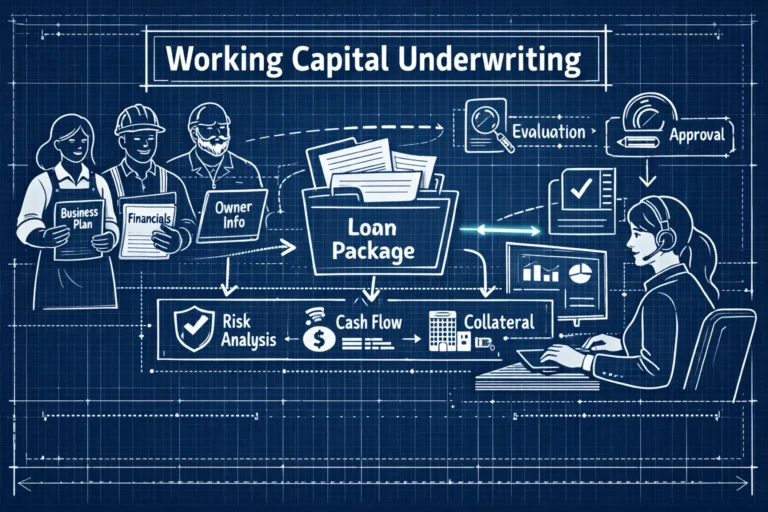
Most brokers know how to package a $50K file. The application goes in, three months of bank statements follow, and underwriting runs its course in a few hours. That process works fine at that size because the exposure is manageable and the decision logic is straightforward. Cross $500K, and the entire framework changes. Underwriting large MCA deals requires a different playbook, one where documentation depth, risk modeling, and deal structure all operate at a categorically higher standard than smaller files demand.
High-ticket merchant cash advance underwriting operates on a different logic than standard files. Documentation requirements expand significantly, risk evaluation goes several layers deeper, and tolerance for incomplete or inconsistent submissions drops to near zero. Funders approving $1M+ against a merchant’s future receivables need a level of confidence that simply isn’t required at the $75K level.
Direct funders like Greenvest Funding have built entire underwriting operations specifically for this tier, processing files from $500K to $5M+ that institutional lenders routinely cap or decline. This guide breaks down the full framework those underwriters use: what they require, what they look for, and what causes a high-dollar file to stall before it ever reaches approval.
Why large MCA underwriting is a different game entirely
Small MCA deals run fast and lean because the exposure is manageable. A $30K advance that goes sideways doesn’t threaten a portfolio. A $1.5M deal that defaults does. This asymmetry is why the underwriting framework for high-ticket MCA transactions operates on fundamentally different principles than what applies to smaller files. The risk ceiling shifts with deal size, and every process around documentation, verification, and deal structure reflects that shift.
At the $500K+ level, funders aren’t just evaluating whether a merchant can repay. They’re evaluating whether the merchant’s business model, cash flow structure, and industry stability support a receivables purchase of that scale over a meaningful time horizon. Risk tolerance tightens, approval criteria become more granular, and documentation requirements expand accordingly. A merchant who sails through a $100K underwriting process can find their $800K file stalled for days over documentation gaps that wouldn’t have mattered at the smaller size.
Banks and traditional lenders generally don’t offer MCA-structured products, and those that participate in adjacent markets typically impose documentation timelines, credit floors, and collateral requirements that make them structurally incompatible with the speed and flexibility large MCA deals require. This gap is exactly where direct funders operate, applying rigorous underwriting frameworks built for file sizes that conventional channels decline or can’t process efficiently.
Brokers who understand this shift can position their files correctly from the start, and that preparation matters more at this tier than at any other. Submitting a $1M+ deal as if it were a $75K deal is one of the most common reasons large files get stuck in underwriting. The expectations are categorically higher, and every element of the submission reflects that.
Underwriting large MCA deals: Revenue thresholds and cash flow metrics
Every large MCA underwriting decision starts with the same question: does this merchant generate enough revenue to support this advance size? The answer isn’t just yes or no. It’s a ratio, and that ratio has to hold up across multiple months of data before underwriting moves forward.
Most funders at this level apply an advance-to-revenue benchmark that defines the ceiling for any single advance. Industry practice commonly references a range of roughly 75% to 150% of average monthly gross revenue for conservative underwriters, though exact thresholds vary by funder and are largely proprietary. A merchant averaging $400K per month in gross revenue might have a theoretical ceiling between $300K and $600K from a conservative funder, depending on their full risk profile. Direct funders with higher risk tolerance may evaluate files at higher multiples when other factors support it, particularly for merchants with strong profiles, minimal stacking, and clean statements. The ratio logic is consistent across the industry; the specific cutoff is not.
Raw revenue figures alone don’t move the needle. Underwriters look for revenue consistency across a three-to-six-month window. A merchant showing $600K in one month and $200K the next creates a volatility problem that will materially reduce the approved amount or require compensating documentation to move forward at all. Large MCA underwriting requires stable, documentable revenue with minimal month-to-month swings. Seasonality is accounted for but must be explained with supporting context, not left for the underwriter to interpret without guidance.
At the $1M+ level, underwriters also calculate implied daily payment obligations and set them against the merchant’s average daily bank balance. The holdback must be serviceable without pushing the merchant into chronic overdraft territory. Funders model implied debt service coverage at this level, with required coverage multiples varying by funder and risk profile. If the math doesn’t work, the advance either gets repriced with a lower holdback or reduced in size.
The documentation stack for a $500K to $5M file
Large MCA deals demand more documentation than standard files, and the gap between the two is significant. Missing critical documents from a large file commonly causes delays that jeopardize approvals. Knowing exactly what’s required before submission is the fastest way to move a high-ticket deal through underwriting without unnecessary back-and-forth.
Core financial documents
The baseline for any large MCA file typically includes six months of business bank statements across all operating accounts, some funders cite a three-to-six-month range for smaller deals, but six months is the practical floor for files above $500K. Also required: three to six months of payment processor statements where applicable, the most recent two years of business tax returns (some funders handling complex profiles may request three years), a current profit and loss statement no older than 90 days, and a current balance sheet. Underwriters cross-reference all of these documents against each other. Inconsistencies between tax returns and bank statements are an immediate red flag that triggers deeper scrutiny and can delay an otherwise clean file.
Entity and ownership documentation
Beyond financials, large deals require full business entity documentation: articles of incorporation or organization, operating agreements, a current certificate of good standing from the business’s state of incorporation, and owner identification. Funders require government-issued ID for every owner with a 20% or greater ownership stake. For deals above $1M, some funders add KYC requirements including background checks on principals. These aren’t optional at this size; they’re baseline requirements that every serious direct funder enforces.
Certain industries and deal profiles trigger additional documentation. A restaurant group going for $1.5M may need to provide lease agreements, equipment ownership documents, or franchiser consent. A healthcare business may need to demonstrate licensing compliance. Real estate-adjacent operations need proof of active projects and revenue sources. Anticipating supplemental requirements before submission prevents the iterative back-and-forth that stalls large files and frustrates merchants who were expecting a fast decision.
How underwriters score industry risk and merchant profile
Not all industries carry the same risk when a funder is advancing $1M+ against future receivables. Underwriters apply industry risk overlays to every large deal, and a merchant in a high-default sector faces tighter conditions regardless of how clean their bank statements look.
Funders maintain internal classifications that group industries by historical default and volatility rates. Restaurants, retail, and hospitality sit in higher-risk tiers because of their sensitivity to consumer spending shifts, seasonality, and thin margins. Healthcare, professional services, and certain B2B service categories typically land in lower-risk tiers because of more predictable cash flows and recurring revenue structures. A $1M file from a restaurant group and a $1M file from a staffing agency will be underwritten with meaningfully different assumptions about risk, even if the revenue figures are identical. Industry classification affects factor rate, holdback structure, and whether additional reserves are required.
Funders use time-in-business as a direct proxy for operational stability. Many underwriters at the $500K+ level prefer to see a minimum of one to three years in business, with that preference strengthening for deals above $1M. Requirements vary across funders, but a three-year-old business with consistent revenue tells a fundamentally different story than a 14-month-old business showing the same numbers. Owner experience, industry tenure, and any prior MCA history all feed into this profile assessment.
Owner FICO scores still matter at the high-ticket level, even though MCA underwriting doesn’t require the same credit floors banks use. FICO minimums vary widely across funders, with some referencing 500+ as a baseline and others setting higher floors for larger advances. Credit score isn’t a standalone qualifier; it’s one signal among many. A low FICO combined with NSF activity and a thin file will stop a large deal regardless of how strong the revenue looks on paper. Paper grading at this level typically runs from A to D, with $1M+ files generally needing to land in the A or B range to receive standard approval terms.
Position stacking and existing debt: how underwriters expose hidden exposure
Position stacking is one of the fastest ways a large MCA deal gets declined, and it’s one of the most common issues in high-dollar files. Underwriters spend significant time mapping a merchant’s existing obligations before they’ll approve anything at this tier. The goal isn’t to penalize merchants for having debt; it’s to accurately calculate whether the merchant’s cash flow can absorb another advance without breaking.
Before any large deal moves forward, the underwriting team pulls a UCC search on the merchant and all related entities. Active UCC-1 filings reveal existing MCA positions, equipment finance liens, bank lines of credit, and any other secured obligations against the merchant’s receivables or assets. The number of active positions, the amount of existing daily payments, and the identity of the funders already in the stack all factor into whether the new deal proceeds and on what terms. Blanket liens from bank lines of credit often supersede all subsequent MCA filings in priority, which changes the risk calculus for the incoming funder significantly.
Not all stacking scenarios kill a deal. A merchant with a single active MCA position at a reasonable factor rate from a reputable funder and a clean payment history may still qualify for a second position from a direct funder with the capacity and risk tolerance to take it on. What kills large deals is undisclosed stacking, multiple active positions with overlapping high holdbacks, or positions from unrecognized funders with aggressive terms. Transparency about existing positions is mandatory at this level. Funders who discover hidden positions after submission will decline the file immediately, and that’s not a recoverable situation for the broker.
Underwriters calculate the merchant’s total daily payment obligation across all active debt, then model what adding the proposed advance does to that number relative to average daily deposits. When total daily obligations represent too large a share of average daily deposits, thresholds vary by funder and are applied to the specific risk profile of each file, most large deal underwriters will reduce the advance amount, restructure the holdback, or decline. Brokers who run this calculation before submission avoid the most common large-file underwriting failure: a good merchant with too much existing exposure to support the requested amount.
Bank statement and payment processor verification for large files
At the $1M+ level, document fraud becomes a serious underwriting concern. Fabricated or altered bank statements appear in MCA pipelines, and underwriters at this tier apply multiple layers of verification before accepting any financial document at face value. This isn’t about distrust of the broker; it’s about the exposure size creating a higher incentive for fraudulent submissions.
Every large file bank statement goes through a document integrity review. Underwriters check for font inconsistencies, metadata anomalies, alignment irregularities, and PDF editing traces. The running balance reconciliation is run against opening and closing balances for every statement period. Mathematical mismatches, future-dated transactions, or deposits that don’t reconcile with processor data are automatic escalation triggers. For files above $1M, many funders cross-reference statements directly with the originating bank or use automated tools that assign authenticity scores to submitted documents. Funders often reference third-party resources such as the comprehensive guide to spotting fraud when evaluating document integrity. A failed reconciliation flag on a single month’s statement will hold up the entire file.
Cash-flow smoothing is more sophisticated than outright fabrication. A merchant or broker who knows underwriting thresholds may time deposits, cluster transactions just below flagging levels, or suppress negative activity from certain months. Experienced underwriters look for deposit patterns that are unnaturally steady, gaps in check sequences, sudden changes in expense behavior, or months where outflows exceed documented inflows without explanation. These patterns are more visible over six months of statements than over three, which is why large deal underwriting almost always requires the longer statement window. Six months is the floor for anything above $500K; three months is adequate only for smaller, lower-risk files.
When a merchant processes card sales, processor statements serve as a secondary verification layer that bank statements alone can’t replicate. Underwriters compare deposit amounts and timing from processor reports against what appears in the bank feed. Volume divergences, fee structures that don’t match reported sales, or processors that appear inconsistent with the merchant’s stated business model all create doubt that triggers deeper review. For merchants where card processing represents a significant portion of revenue, processor statements are treated as a required document, not an optional supplement.
Pricing, factor rates, and holdback structures for large advances
Pricing a $1M+ MCA deal is more nuanced than applying a standard factor rate to a revenue figure. Underwriters at the large deal level model multiple scenarios and land on structures that reflect the specific risk profile of each file. Understanding how pricing is set helps brokers frame deals accurately for merchants and avoid friction that comes from unexpected terms at closing.
Factor rates for large MCA deals generally fall within the broader industry range of roughly 1.1 to 1.5. Files with risk flags, stacking, or industry concerns price toward the higher end; files from repeat borrowers with strong performance history, clean statements, and low-risk industry profiles price toward the lower end. Unlike smaller deals where rate sheets are more standardized, large deal pricing reflects a genuine risk model built from the specific variables of each file. Brokers who try to negotiate pricing before presenting a complete file are working backward: pricing follows documentation, not the other way around.
Holdback rates on large MCA deals typically fall somewhere between 5% and 20% of gross daily or weekly sales, depending on advance size, revenue consistency, and whether the deal carries additional risk factors. The calibration target is a daily payment that keeps the merchant operational while providing the funder with steady, predictable remittance. Underwriters model implied repayment scenarios across different holdback rates and select the structure that balances both objectives. Reconciliation provisions allow adjustment if revenue drops materially, and including them in large deal structures reduces legal risk under bankruptcy scrutiny.
Reserve structures are a tool funders use when a file doesn’t quite meet the clean-file threshold but still represents a fundable deal. A portion held from the funded amount, illustratively cited as 3% to 8% by some providers, though this varies, gives the funder a buffer against early default. Reserve requirements are more common above $1.5M and in deals where the merchant profile carries mild risk indicators. Brokers should treat a reserve offer as a funding path, not a rejection. It’s often the mechanism that gets a borderline file across the finish line when it wouldn’t otherwise clear approval thresholds.
Recourse structures, personal guarantees, and legal protections
Large MCA transactions require more robust legal protection than smaller deals because the exposure is higher and recovery, if needed, is more complex. Underwriters build a legal structure around every large file that defines what happens if the merchant’s performance falls short. Getting this structure right is as important as getting the financial metrics right.
Personal guarantees are standard in large MCA deals and cover every principal with meaningful ownership. At the $500K+ level, guarantees are almost universally required and go beyond symbolic risk-sharing. They make individual owners directly liable for performance obligations tied to the merchant’s sales delivery. The guarantee structure must align with the purchase-of-receivables nature of the MCA to avoid recharacterization as loans in bankruptcy. Broad unconditional guarantees that cover fixed payment shortfalls independent of sales performance create legal exposure for the funder. Personal guarantees of performance, scoped to the merchant’s actual sales obligations, are the correctly structured version at this level.
Confessions of judgment were widely used in MCA enforcement for years because they allowed funders to obtain judgments without prior notice to the merchant. Several states, including New York, California, Connecticut, and Maryland, have now restricted or banned COJ use against out-of-state or in-state borrowers. Large deal underwriting requires a state-specific assessment of which enforcement tools are available in the merchant’s operating jurisdiction. Security interests in receivables and business assets, properly perfected via UCC-1 filings, remain the most consistently enforceable protection across most states and are the primary recovery mechanism in regulated jurisdictions.
Courts have recharacterized MCAs as loans when contract terms include fixed repayment amounts regardless of sales, no meaningful reconciliation provision, and unlimited personal recourse for shortfalls. Large deal underwriters and their legal teams structure contracts specifically to preserve true-sale status: variable remittance tied to actual sales, meaningful reconciliation triggers, and personal guarantees scoped to sales performance rather than unconditional debt payment. At the $1M+ level, funders with in-house legal capacity review deal documentation before funding to ensure the structure holds under the laws of the merchant’s state.
State-level compliance and UCC filing requirements
A large MCA deal that is properly underwritten on financial metrics can still create serious legal and recovery problems if the funder hasn’t accounted for the state-specific regulatory environment the merchant operates in. This layer of underwriting is often overlooked by brokers and is a growing source of deal complications as more states enact MCA-specific legislation. For a practical reference, brokers and funders frequently consult a 50-state overview of MCA laws to understand how requirements vary by jurisdiction.
California, New York, Connecticut, Virginia, and Maryland have all enacted disclosure requirements, licensing mandates, or enforcement restrictions that directly affect how MCA deals must be structured and documented. California requires full APR-equivalent disclosure and has levied significant fines for non-compliance. Virginia requires licensing and similar disclosure standards. Connecticut voids COJs against in-state merchants and requires lender registration. Underwriters handling large deals in these states apply additional compliance screening before approving files, and deals that can’t be structured in compliance with applicable state law are declined or restructured before funding.
UCC-1 filings are how MCA funders publicly perfect their security interest in the merchant’s future receivables. For large deals, lien position in the UCC record determines priority in recovery if multiple creditors have filed against the same merchant. First-position UCC liens provide stronger recovery rights than second or third-position filings. Large deal underwriters pull the full UCC record and assess lien order before approving. Identifying existing bank credit facilities is a non-negotiable step in large file due diligence, since blanket liens from bank lines of credit can supersede subsequent MCA filings in priority. Accurate debtor name searches are also essential; common mistakes when filing a UCC-1 show how minor errors in a UCC filing can render it ineffective, potentially hiding prior liens and creating undisclosed stacking risk.
Recovery planning starts in underwriting, not after a default. States that ban COJs force funders to rely entirely on civil litigation to pursue non-performing merchants, which is slower, more expensive, and less certain. States that permit COJs or maintain more permissive enforcement environments allow faster recovery on defaulted large deals. Large deal underwriters factor recovery environment into pricing: deals in high-litigation-risk states price higher to offset slower recovery timelines. Brokers who understand this dynamic can better explain to merchants why pricing varies across geographies, without that difference appearing arbitrary.
How brokers package a $1M+ file that clears underwriting the first time
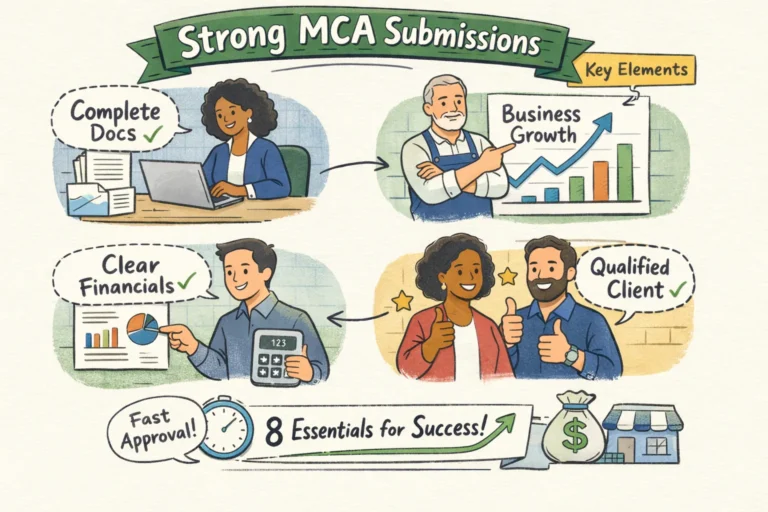
Everything in the underwriting framework above translates into a practical set of actions brokers can take before submission. The difference between a large file that clears in 24 hours and one that bounces back for re-documentation is almost always preparation, not deal quality. Strong merchants with fundable files lose deals to underwriting delays regularly because the submission wasn’t ready at the level the file size demands.
Before submitting any file above $500K, run through this checklist:
- 6 months of bank statements from all operating accounts (not 3)
- Current processor statements that align with bank deposit records
- 2 years of business tax returns (note: some funders request 3 years for complex profiles)
- A 90-day-or-less P&L and balance sheet
- Full entity documentation and owner ID for all principals above 20% ownership
- Clear disclosure of all active MCA positions and existing UCC liens
- A soft UCC search result showing what the underwriter will see
Running a soft UCC search before submission tells the broker what the underwriter will find and allows pre-emptive explanation of anything that could trigger concern. An undisclosed lien discovered by the funder always reads as a red flag. The same lien disclosed proactively by the broker, with context, reads as thorough preparation. The documents are identical; the framing is entirely different.
Underwriters are not trying to find reasons to decline. They’re trying to understand whether a deal makes sense. When a merchant has a legitimate explanation for a two-month revenue dip, an industry-related expense spike, or a prior MCA with an unusually high factor rate, that context should be in the file as a broker’s note or executive summary. A well-packaged large file includes a brief deal narrative that explains the merchant’s business model, the use of funds, any notable items in the statements, and why the deal represents a sound receivables purchase. This single practice separates brokers who close large deals consistently from those who don’t. It gives the underwriter the context to approve rather than the ambiguity that justifies a decline.
Choosing the right direct funder matters as much as packaging the file correctly. Not every funder is built to underwrite large MCA deals at this level. Many institutional and retail funders cap advances well below $1M, and those that don’t often move too slowly or lack the internal infrastructure to handle complex documentation at speed. Greenvest Funding operates in this tier specifically, with underwriting capacity for deals from $500K to $5M+. For ISOs and brokers building a business on large commercial files, the right funder relationship makes more difference than almost any other factor. Greenvest’s dedicated ISO support line means brokers aren’t left waiting for updates on files that represent significant commissions.
Closing the knowledge gap on high-ticket MCA underwriting
Underwriting large MCA deals at the $500K to $5M+ level is a discipline that rewards preparation, documentation, and a working knowledge of how funders actually make decisions. Revenue ratios, position stacking, industry risk, fraud detection, legal structure, and state compliance all feed into the underwriter’s final call. Brokers who understand this framework package stronger files, anticipate what will surface during review, and close at a higher rate on the deals that matter most.
The fundamentals hold at every deal size: clean statements, full documentation, no hidden positions, and a merchant whose cash flow genuinely supports the advance. Get those right consistently, and underwriting large MCA deals becomes a process you can manage and scale rather than a variable you’re guessing at with every submission. Factor rates, holdback structures, reserves, and legal protections are all negotiable within a range, but none of that conversation happens without a complete, well-prepared file that gives the underwriter what they need to approve.
If you’re focused on underwriting large MCA deals and need a direct funder with the capital capacity and underwriting depth to match, Greenvest Funding is built for exactly this tier. Reach out to our broker support line to discuss deal parameters, or submit your next $500K+ file through our ISO portal. Our underwriting team is structured to move quickly on well-prepared submissions, and to work with brokers who take the same approach to preparation that we take to funding decisions.