
Greenvest Funding Review: Rates, Terms & How to Apply
If you searched “Greenvest Funding,” you landed in the right place. This is the independent review of Greenvest Funding, the direct commercial lender operating at greenvestfunding.com, offering working capital advances from $100,000 to $5,000,000 for U.S. businesses and broker networks.
Before we go further, there’s one thing worth flagging: several companies use the Greenvest name across completely different industries. We’ll clear that up in the first section so you’re not reading the wrong review. Once we establish who Greenvest Funding actually is, we’ll cover everything you need to make a decision, their products, deal sizes, rates, underwriting philosophy, the ISO broker program, and how to apply.
What sets Greenvest Funding apart in the alternative commercial lending space comes down to speed, scale, and broker protection. According to the company’s marketing, that means decisions in as little as one hour and same-day disbursement on approved files, working capital advances up to $5 million that most direct funders can’t match, and a hard no-backdooring guarantee that’s rare in this industry and rarer still as a contractual commitment. Whether you’re a business owner looking for capital or an ISO evaluating a new funder partner, this review covers the substance you need.
First, let’s confirm you’ve found the right Greenvest
Searching “Greenvest” pulls up results across multiple companies in completely unrelated sectors. There are at least four distinct entities operating under the Greenvest name, and confusing them wastes your time and potentially sends you to the wrong business altogether.
The four “Greenvest” entities and why they matter
Greenvest Funding (greenvestfunding.com) is the direct commercial lender this article covers: working capital advances, ISO partner programs, and capital solutions for business owners who can’t wait on conventional lenders. That’s the business you’re researching.
The other three are distinct operations with no connection to commercial lending:
- Greenvest LLC (greenvestus.com), a land restoration and environmental services firm headquartered in Bowie, Maryland, with roughly $7.4 million in annual revenue serving nonprofits and government clients.
- Greenvest (greenvest.com), a Vermont-based investment advisory firm that holds a B Corporation certification and focuses on socially responsible investing.
- Greenvest (greenvest.biz), a financial solutions company oriented toward the produce industry.
None of these are the capital source for business owners or ISO partners. If you’ve encountered any of them in your research, set them aside.
What Greenvest Funding actually does
Greenvest Funding is a direct funder, not a broker desk, marketplace, or syndication platform. They deploy their own capital, make their own underwriting decisions, and fund directly into the borrower’s account. That distinction matters more than it might seem at first. When a business owner works with a direct funder, they’re dealing with the decision-maker, no middleman passing files up a chain and waiting for a committee answer. When an ISO submits a deal to Greenvest, they’re working with the source of capital, which eliminates the syndication delays and exposure risks that come with stacked intermediaries.
Their primary product is working capital advances structured against future receivables, built for speed and flexibility rather than for borrowers who fit a tidy bank template. The company also markets itself as a GreenVest capital solutions provider for complex commercial files that institutional lenders decline on technical grounds rather than fundamental business risk.
Where Greenvest operates and its market presence
Greenvest operates nationally across the United States, serving any U.S.-based business that qualifies under their underwriting criteria. Geography is generally a non-issue for the majority of applicants. The company also markets an active presence at industry events in the alternative finance space, including Broker Fair NYC and deBanked CONNECT Miami, though independent confirmation of specific deal geography or event attendance was not available at the time of this review. Showing up at venues where high-volume ISOs and direct funders network signals a commitment to operating at the professional level of this industry.
Working capital advances: deal sizes, use cases, and who qualifies
The flagship product at Greenvest Funding is the working capital advance. Structured against future receivables rather than as a traditional term loan, these advances give businesses access to capital quickly without the underwriting constraints that make bank lending slow and inflexible. The range runs from $100,000 to $5,000,000 or more, covering a wide swath of business situations, from a mid-market operator in a cash flow crunch to a multi-location business executing a growth move.
How the $100K to $5M+ range breaks down in practice
At the lower end of the range, advances between $100,000 and $300,000 typically serve established businesses that need a quick capital injection to cover a gap, seize an opportunity, or bridge a timing mismatch in receivables. A services firm waiting on a large invoice, a retail operator stocking up before peak season, or a contractor mobilizing for a newly won contract all fit this tier. These are illustrative use cases based on standard industry patterns for advances in this range.
The mid-range, roughly $300,000 to $1,000,000, tends to serve businesses making deliberate capital moves: acquiring equipment, funding an expansion, refinancing expensive short-term debt, or building out new capacity. Above $1,000,000, you’re looking at multi-location operators, businesses with strong revenue bases, and situations that require substantial working capital to execute a defined strategy. Greenvest’s stated capacity to fund at this level without requiring institutional timelines is one of their clearest differentiators in the market.
Business types and situations Greenvest funds
Greenvest explicitly targets business segments that traditional lending consistently underserves. Minority-owned businesses, veteran-owned businesses, and women-owned businesses are named customer categories, not as charitable designations but as markets where institutional lending falls short and alternative capital fills a real need. Beyond ownership demographics, Greenvest serves businesses across sectors where banks apply conservative underwriting due to industry risk codes, revenue seasonality, or documentation complexity. A business with strong revenues but a non-standard income structure often fails a bank’s template while presenting a fundamentally sound capital opportunity. That’s exactly the kind of file Greenvest underwrites.
Special situations: when a working capital advance makes sense
Speed and flexibility have a price in alternative finance, and that price is almost always higher than a conventional bank loan. The situations where a working capital advance makes strategic sense are the ones where that premium is justified by the economics. A competitor acquisition that requires capital in days rather than months. An equipment failure that’s stopping production and costing more per day than the advance will cost over its term. A contract win that requires cash deployment before the invoice cycle catches up. Debt refinancing to replace multiple high-frequency payments with a single advance. In each scenario, the cost of waiting outweighs the cost of the advance. That’s the framework for evaluating whether this product fits your situation.
Same-day funding and the 1-hour decision: how it actually works
The claim of 1-hour decisions and same-day funding is one of Greenvest Funding’s most prominent marketing points. The company markets these capabilities as real, but they’re conditional, and understanding what makes a fast close possible, and what causes the timeline to extend, is critical for any borrower trying to plan around a capital need. Independent verification of these timelines is limited; what follows reflects the company’s stated process and general industry practice for prepared applicants.
The application process from start to decision
The process begins with an online inquiry form at Greenvest Funding. Once submitted, Greenvest’s underwriting team reviews the file using a business-health-first approach: bank statement deposits, cash flow consistency, revenue trends, existing advance balances, and the overall health of the business as a going concern. The “1-hour decision” applies to standard files where documentation is complete, the business profile is clear, and the advance request falls within parameters the underwriting team can evaluate quickly. It’s a focused, efficient review by an experienced underwriting team that doesn’t need six committees to reach a conclusion.
What same-day disbursement requires from the applicant
Same-day funding requires the applicant to do their part. Complete documentation submitted early in the business day. Responsive communication during underwriting review. Prompt execution of agreements when the offer is presented. A voided business check for ACH disbursement setup. Any delay on the borrower’s side converts a same-day close into a next-day close, the process requires both sides to move. Come prepared, respond quickly, and same-day funding is genuinely achievable for qualifying files.
When the timeline extends and why
Larger deal sizes typically require deeper underwriting review. A $250,000 advance and a $2,000,000 advance are not the same underwriting exercise, and treating them as equivalent would be irresponsible on Greenvest’s part. Incomplete submissions, missing bank statements, or unclear business structures add review time regardless of deal size. Special situations, like businesses with multiple funding positions already outstanding, also require more thorough analysis. None of this represents a process failure. It’s responsible underwriting applied at the appropriate depth for the deal at hand. Borrowers who prepare complete packages and stay available to answer questions move fastest through the process.
Greenvest Funding rates, terms, and what to realistically expect
Greenvest Funding does not publish a standard rate sheet. This is consistent with how direct funders across the alternative lending market operate, and it’s worth understanding why before interpreting the absence of published rates as evasion.
Why alternative funders don’t advertise fixed rates
Working capital advances and merchant cash advances are priced using factor rates, not annual percentage rates. A factor rate of 1.25 on a $500,000 advance means the total repayment amount is $625,000, regardless of how quickly the business repays. The factor rate itself varies based on the specific borrower profile, the advance size, the industry, the repayment term, and the health of the business’s receivables. Industry data from sources including deBanked and Fundera puts typical factor rates across the MCA market at roughly 1.10 to 1.50 for 2025, 2026, with the effective cost depending heavily on how quickly repayment occurs. The rate you receive is determined by your specific file, not a published menu. Requesting a quote is the only way to know where your deal lands.
Variables that influence your Greenvest offer
Several factors determine the strength of the offer you receive. Monthly revenue and its consistency across your bank statements is the primary driver, lenders want to see stable deposit patterns, healthy average daily balances, and a business that clearly generates enough cash flow to support the advance repayment. Time in business matters, with established operations generally receiving better terms than businesses in their early years. Your existing debt load, including any active MCA positions, affects both the amount you can access and the rate you’ll pay. Industry type carries weight because some sectors are viewed as higher risk based on default rates. The intended use of funds, when clearly communicated, helps underwriters assess whether the advance makes sense for the business.
How to evaluate any working capital offer fairly
When you receive an offer from Greenvest Funding or any direct funder, a sound evaluation looks at four things. Total payback amount: how much do you repay in total. Repayment cadence: daily or weekly, and at what percentage of your revenue. Effective cost relative to the business opportunity the capital enables: is the deal you’re funding worth more than the advance costs. And prepayment options: does the funder allow early payoff, and does doing so reduce your total cost. Comparing offers across funders should use these consistent criteria rather than fixating on factor rate alone, since a lower factor rate with a faster repayment schedule can actually cost more in daily cash flow impact than a higher rate with a longer term.
The ISO and broker partner program: structure, protections, and earning potential
A substantial portion of readers researching Greenvest Funding are ISOs and commercial finance brokers evaluating them as a funder partner. If that’s you, this section covers the program details that matter for making a real business decision. For borrowers, the next section on eligibility and application is where you’ll want to focus.
How Greenvest’s ISO program is structured
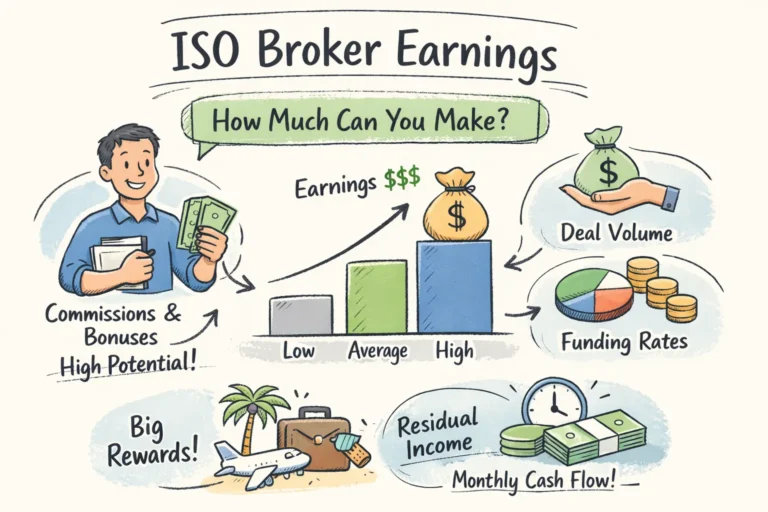
The partner program is built for high-volume ISOs and experienced brokers who handle large commercial files. Applicants submit a partner inquiry through Greenvest’s partner page, and Greenvest evaluates the ISO’s business legitimacy, deal volume capacity, and operational setup, including confirmation of a valid EIN. Commission structures in the direct funder space typically range from 0% to 15% of the funded amount depending on deal size, term, and program specifics. Industry-standard payout ranges for programs at this capacity level tend to fall between 5% and 12% for qualified partners on qualified deals, though the exact structure for Greenvest partners is confirmed during the onboarding process rather than published publicly. The company states that ISO partners receive direct access to the team rather than a voicemail queue or generic support email, though partner experience will vary.
The no-backdooring guarantee: what it means and why it matters
Backdooring is a documented problem in the MCA industry. It happens when a funder, after receiving a client introduction from a broker, makes direct contact with that client to offer future funding without the broker’s involvement, effectively cutting the broker out of commissions they earned by originating the relationship. It costs brokers real money on renewals and repeat deals. Greenvest’s hard no-backdooring guarantee is presented as a contractual commitment that your client relationship and your commissions stay protected. For brokers who’ve been burned by funders that claimed not to backdoor and then did it anyway, this distinction carries significant weight when choosing a primary funder relationship. The difference between a verbal assurance and a contractual guarantee is the difference between a business relationship and a risk exposure.
The direct ISO support line and deal submission process
Greenvest states that ISO partners have access to a dedicated direct support line rather than a generic customer service number. The company describes a structured deal submission process in which the broker submits the file with a complete documentation package, underwriting reviews and communicates status, and the broker receives updates throughout rather than waiting in silence. For ISOs managing multiple files simultaneously, funder communication quality is a significant operational factor, a funder who goes dark during underwriting costs brokers time and client credibility. Greenvest’s stated partner-first model is designed to address that pain point, though prospective partners should confirm these operational specifics during onboarding.
Aggressive underwriting: the files Greenvest funds that banks decline
Greenvest positions itself as the capital source for large, complex, or institutionally-declined files. Understanding why banks pass on fundamentally sound deals clarifies exactly where Greenvest’s underwriting model creates value.
Why institutional lenders decline viable commercial files
Banks operate inside rigid underwriting templates built for risk management at scale, not for individual business nuance. A credit score below the cutoff triggers an automatic decline regardless of the business’s actual health. Industry codes considered high-risk by regulators get capped or declined regardless of the individual operator’s track record. Revenue documentation requirements designed for W-2 employees don’t accommodate the income structures of contractors, real estate operators, or cash-intensive businesses. Loan size caps prevent banks from meeting the capital needs of mid-market borrowers, and approval timelines of 60 to 90 days make banks operationally useless for any situation requiring fast capital. None of these rejections necessarily mean the business is a bad credit risk. They mean the business doesn’t fit the bank’s template, a fundamentally different problem. For more context on the broader shift in bank lending trends, see analysis of the decline in bank lending to businesses.
What Greenvest looks at instead
Greenvest underwrites based on overall business health rather than template compliance. The core questions are straightforward: does this business generate consistent revenue, does it have the cash flow capacity to support the repayment, and does the advance make sense given the business’s situation and intended use of funds. Bank statements, revenue trends, and operational history carry more weight than credit score alone. “Aggressive underwriting” in this context means a willingness to evaluate the full picture of a business’s health, considering credit score as one data point among many rather than as a hard disqualifier.
Illustrative deal scenarios: what a Greenvest-funded deal looks like
The following examples are illustrative scenarios based on the types of situations Greenvest’s products are designed to address. They are not verified historical transactions.
A multi-location food service operator with $1.8 million in annual revenue and a strong operational track record finds their bank declines a $750,000 working capital request because the industry SIC code falls into a restricted category despite strong financials. An alternative funder reviewing the revenue, bank statement health, and clear ability to service the advance can approve and fund that deal where a bank cannot.
A real estate investor needs to close a $1.5 million acquisition within seven days to meet the seller’s conditions. Conventional financing needs 60. Bridge financing from a direct funder closes the deal in the required window, and the investor transitions to a conventional mortgage after stabilization.
A minority-owned professional services firm with $220,000 in annual revenue but a thin personal credit history, never above 640, has been operating profitably for four years with clean bank statements and zero NSF activity. A $250,000 advance based on business health rather than credit score gets the capital moving within one business day of a complete submission.
These scenarios represent the core use cases Greenvest is built to serve: situations where institutional underwriting fails on technical grounds rather than fundamental business risk.
Eligibility requirements and how to apply: a step-by-step guide
This section gives you the practical information you need to prepare a strong application and understand exactly what happens between submission and funding.
What Greenvest looks for in a business applicant
Greenvest’s underwriting centers on overall business health rather than any single qualifying metric. Certain signals consistently drive strong applications: established operations with meaningful time in business (typically one year or more), monthly revenue sufficient to support advance repayment without straining operations, and bank statements that show consistent deposits, healthy average daily balances, and minimal overdraft activity. Your existing debt load is also considered, an over-leveraged business relative to the advance being requested will face more scrutiny. Industry type is a factor but is not automatically disqualifying the way it is with institutional lenders. The intended use of capital, when communicated clearly, helps underwriters assess whether the advance fits the business’s situation. Businesses with complex ownership structures or multiple existing MCA positions should expect a more thorough review, which is appropriate given the additional due diligence required.
Documentation to prepare before you apply
For a working capital advance in the standard range, a complete documentation package typically includes:
- Three to six months of business bank statements covering your primary operating accounts
- Business tax returns for the most recent filing year or two, particularly for larger advance requests
- A voided business check for the account where funding will be received and repayments withdrawn
- Government-issued ID for the business owner or primary signer
- Proof of business ownership (EIN letter, articles of incorporation, or equivalent state registration document)
- For advances above $500,000: profit and loss statements or additional financials that give underwriters a fuller picture of business performance
The key principle is straightforward: complete submissions move faster than incomplete ones. Assembling this package before you submit puts you in the fastest lane available.
The step-by-step Greenvest Funding application process
- Submit the online inquiry form at greenvestfunding.com with your basic business information and capital need.
- Complete the formal application, which captures the details needed for underwriting review including ownership information, revenue figures, and use of funds.
- Provide your documentation package: bank statements, tax returns, ID, voided check, and any additional financials for larger requests.
- Underwriting review: for standard files with complete documentation, this takes approximately one hour per the company’s stated process. Larger or more complex files may take longer.
- Receive your offer: Greenvest presents the advance amount, factor rate, repayment structure, and term. Review it carefully using the evaluation framework covered earlier in this article.
- Execute the agreement: once you accept the offer and sign the funding agreement, the disbursement process begins.
- Receive funding: for applications approved and executed early in the business day with complete documentation, same-day disbursement is the company’s stated standard outcome for qualifying files.
The process is linear and fast when both sides are prepared. Working directly with the funder rather than through a chain of intermediaries keeps communication clean at every stage.
How Greenvest stacks up against other direct funders
The alternative commercial lending space includes dozens of direct funders, syndication desks, and marketplace platforms. Comparing them honestly across dimensions that actually matter, rather than surface-level marketing claims, gives you a realistic picture of where Greenvest Funding sits and when a different option might serve you better.
Speed and deal size: where Greenvest leads
Most direct funders in the MCA and alternative working capital space operate comfortably up to $250,000 to $500,000 and require 24 to 48 hours for decisions. At that scale and speed, many funders are competitive. The differentiation becomes clear above $500,000, where deal complexity increases and institutional-style timelines start creeping back in at most funders. Greenvest’s combination of $5 million capacity and rapid decisions on larger files occupies a position that most alternative funders can’t simultaneously match. For ISOs managing high-dollar pipelines, the ability to bring a $1.5 million or $2 million file to a funder who can decide quickly and fund the same day is not a minor operational convenience. It’s the capability that determines whether the deal closes on the client’s timeline or stalls waiting for committee approval.
Commission protection across the industry
Backdooring is documented, widespread, and underreported in the MCA industry, brokers who lose clients to a funder’s direct outreach often don’t know it happened until a renewal conversation reveals the funder already funded the client independently. Many funders claim verbally that they don’t engage in backdooring. Very few put a hard guarantee in writing as a contractual protection for their ISO partners. Greenvest’s no-backdooring policy is a structural competitive advantage for brokers choosing a primary funder relationship. When you’re selecting a funder to bring your best clients to, the difference between a verbal assurance and a contractual guarantee is the difference between a protected business relationship and an ongoing risk exposure. Other direct funders in the market operate without this guarantee, which means the broker’s client relationship is protected only by goodwill rather than enforceable terms.
When a different funder might be a better fit
Honest comparison includes acknowledging where Greenvest isn’t the right answer. Startups operating under one year in business typically don’t have the operational history Greenvest’s underwriting can work with. Very small advance requests under $50,000 fall below the minimum that Greenvest’s deal structure is designed for, and other funders serve that segment better. Borrowers who specifically need a fixed-rate, long-term loan with monthly payments should look at SBA programs or community development lenders if their timeline permits. Borrowers who qualify for conventional financing and can wait 60 to 90 days should use it, the cost structure of traditional loans is lower than alternative capital. Greenvest is the right choice when the combination of speed, deal size, and complexity makes conventional options impractical.
Who Greenvest Funding is the right fit for
Everything covered in this Greenvest Funding review leads to a single practical question: is Greenvest the right capital partner for your specific situation? The answer depends on your profile, your timeline, and your priorities.
The ideal borrower profile
The business owner who gets the most value from Greenvest is running an established operation with $100,000 or more in monthly revenue, faces a capital need with meaningful time pressure attached, and either can’t qualify for conventional financing or can’t afford to wait for it. Businesses declined by institutional lenders due to industry type, credit profile complexity, or documentation structure are prime candidates. Operators with strong revenues but non-traditional income documentation are a natural fit. The product is designed for borrowers whose business fundamentals are sound but whose situation doesn’t conform to what banks can process on a useful timeline.
The ideal ISO and broker partner profile
The broker who benefits most from a Greenvest Funding partner relationship is handling large files regularly, needs a direct funder with genuine capacity at the $500,000 to $5,000,000 level, and has been frustrated by funders who either slow deals with syndication layers or expose client relationships through backdooring. ISOs who are done submitting their best files to funder networks only to discover their client was contacted directly six months later will find Greenvest’s contractual protection to be a substantive business advantage. The direct support model matters too, because high-volume brokers can’t afford funders who go dark during underwriting and leave them explaining delays to the client.
Signals that Greenvest is the right call
The decision criteria are relatively clear. Your deal or your client’s deal is over $100,000. Speed is non-negotiable, whether because of a business opportunity, a time-sensitive acquisition, or an urgent operational need. The file has been declined or capped by an institutional lender. Commission protection is a requirement for your brokerage business, not a nice-to-have. When these conditions are present, Greenvest Funding checks the relevant boxes: direct capital, rapid decisions, same-day funding on qualifying files, aggressive underwriting on complex files, and a no-backdooring guarantee that protects client relationships as a matter of policy.
The bottom line on Greenvest Funding
Greenvest Funding occupies a specific and valuable position in the alternative commercial lending market. What distinguishes their offering from most direct funders comes down to three things they can simultaneously deliver: rapid decisions with same-day funding at deal sizes reaching $5 million and beyond; a hard no-backdooring guarantee that gives ISO partners genuine contractual protection rather than a verbal assurance; and business-health-first underwriting that funds large, complex, or institutionally-declined files based on revenue and cash flow rather than credit score compliance.
For established businesses facing time-sensitive capital needs, and for ISOs who need a high-capacity direct funder that respects their client relationships and commissions, Greenvest is not a compromise choice. It’s a primary solution built for situations where conventional lending fails on speed, flexibility, or capacity.
The application process is direct and fast when you’re prepared. Assemble your documentation, submit through greenvestfunding.com, and you can have a decision quickly and funding the same day if your file is complete and your business qualifies. If your situation fits the profile described in this review of Greenvest Funding, the next step is a conversation with the Greenvest team, not another approval committee with a 60-day clock. Submit your file and let the underwriting speak for itself.