How to Get Approval on a Large Merchant Cash Advance File
You put together what looks like a strong file. Solid revenue, a legitimate business, a real funding need. You submit it to three funders and get back silence, a 10-day timeline estimate, or a counter offer at half the amount you requested. If you’ve ever asked yourself “how do I get approval for a large merchant cash advance?”, that frustration is exactly what this guide is built to solve. Most brokers and business owners hit that wall because they push large MCA files through the pipeline without understanding how the underwriting side actually works.
Getting approval on a $500K, $1M, or $2M+ advance is an entirely different game from closing a $50K deal. The document requirements are deeper. The review process is more intense. The margin for error is smaller because the funder’s exposure is exponentially higher. Senior underwriters handle these files, and they look for things a standard MCA checklist doesn’t cover.
The good news: this process is completely navigable when you know the playbook. Direct funders like Greenvest Funding issue 1-hour decisions on complex, high-dollar files that institutional lenders stall on or decline outright. The difference between an approval and a denial at that level almost always comes down to preparation, disclosure, and presentation. This guide walks through every layer of the review process so you walk in ready.
What makes a large MCA file different from a standard advance
A $25K advance and a $1M advance are not the same product with different numbers attached. They trigger entirely different underwriting processes, different document requirements, and different levels of internal scrutiny. Understanding that distinction is the first step to positioning a large file successfully.
The underwriting threshold where review intensity changes
Most funders operate on internal tier systems. Files below $100K move quickly through a standardized review: three months of bank statements, a credit pull, basic identity verification, and a funding decision often within 24-48 hours. Once a file crosses $100K-$150K, the process escalates. At $250K, you’re in senior underwriting territory. At $500K and above, expect a comprehensive document package, multiple verification steps, and potentially a merchant phone interview before an offer is structured.
These thresholds exist because the funder’s capital exposure scales directly with the advance amount. At $25K, a default is manageable. At $1M, it’s a meaningful balance sheet event. Funders respond by building more checkpoints into the process, and every checkpoint is an opportunity for an unprepared file to stall or get declined.
Why senior underwriters handle high-dollar MCA applications
Large advance files don’t go through the same queue as standard submissions. They land with senior underwriters who have the authority to approve non-standard terms, the experience to evaluate complex business situations, and the judgment to make calls outside an automated scoring model. These underwriters verify more, question more, and cross-reference more than their counterparts handling smaller files.
On a large file, expect them to analyze bank statements line by line, verify merchant processing volumes against bank deposits, look for ACH patterns that signal undisclosed obligations, and sometimes review the actual business model to understand how the revenue is generated. That depth of review is why large files take longer at most funders, and why the quality of your submission package directly determines how long that review takes.
How the approval timeline changes with deal size
Small advances under $100K typically fund within 24-72 hours at most funders. Large advances, anything above $100K-$150K, regularly take 3-5 business days or longer, once you account for additional document verification, senior approval sign-off, and potential back-and-forth on missing information. That timeline compounds when a file arrives incomplete or when the broker isn’t responsive to information requests.
Direct funders with in-house underwriting and dedicated senior staff can compress that timeline significantly. Greenvest Funding targets 1-hour decisions on clean, complete files regardless of deal size. This isn’t a marketing promise. It reflects what happens when a funder owns the capital, controls the underwriting process internally, and doesn’t route files through external credit committees. Preparation on your end is what enables speed on their end.
Revenue benchmarks for getting approval on large MCA files
Before you submit a large file, you need to know whether the underlying business qualifies. Underwriters apply consistent revenue-to-advance formulas, and knowing those formulas upfront tells you what deal size is realistic and what will get countered down immediately. For guidance on basic eligibility, see how businesses typically qualify for a merchant cash advance.
The revenue-to-advance ratio most funders apply
From what we see across submissions, MCA funders typically advance between 50% and 150% of average monthly gross revenue. In practice, a business needs to show consistent monthly deposits in the range of 50-100% of the requested advance amount. For a $500K advance, that typically means demonstrating $250K-$500K in average monthly gross deposits over the review period. The key word is average: underwriters pull this from 3-6 months of bank statements and calculate a mean, not a peak.
Submitting a file based on a single strong month is a mistake that wastes everyone’s time. Underwriters average the full statement period, and if two of those six months were significantly lower, the approved amount adjusts accordingly. Know your client’s trailing average before you position the deal size.
Minimum credit card processing volume for large MCA approval
General minimums for basic MCA products sit around $10,000-$15,000 in monthly credit card processing volume. For large advance files, the bar is higher in practice even when it isn’t written into formal eligibility criteria. A business processing $15K/month in card volume is not going to qualify for a $500K advance. Underwriters look for processing volume proportional to the advance amount and, critically, they look for consistency across 3-6 months of merchant statements rather than relying on any single month’s performance.
If the business runs primarily on ACH deposits rather than card processing, the merchant statement piece of the package is less relevant, but the bank statement analysis becomes even more important. Funders will look at total deposit volume and frequency to substitute for the card processing picture.
How seasonal revenue is evaluated for large advance files
Seasonal businesses face a higher bar on large files because the repayment structure of an MCA doesn’t pause during slow periods. A holdback deducted daily or weekly against card volume continues regardless of whether the business is in peak season or trough. Underwriters want to confirm that the business can sustain those deductions during its slowest months without running into cash flow stress.
For seasonal businesses, submitting 12 months of bank statements rather than the minimum 3-6 is a strong move. Year-over-year comparisons showing consistent revenue patterns across multiple cycles help underwriters model repayment risk accurately. If there’s a natural slow season, acknowledge it with context in your submission rather than hoping the underwriter doesn’t notice the February revenue dip.
Bank statement analysis: what underwriters look at line by line
Bank statements are the single most important document in a large MCA file. Most applicants treat them as a formality. Experienced underwriters use them as a forensic financial picture. Knowing what they’re looking for helps you identify problems before submission and address them proactively.
Average daily balance and why it matters more than total deposits
Total monthly deposits tell underwriters what revenue the business generates. Average daily balance tells them how well the business manages its cash. A business depositing $300K/month but maintaining an average daily balance near zero is running on fumes, every dollar coming in is going right back out, with no liquidity cushion to absorb a daily holdback deduction. Underwriters flag this pattern immediately on large advance files.
A useful internal benchmark: average daily balance should represent at least 5% of monthly revenue. A business with $400K/month in revenue that consistently maintains a $20,000+ daily balance is showing cash management discipline. A business with the same revenue that dips to zero regularly is showing strain. Both files look identical on total deposit volume. They look very different once a senior underwriter runs the daily balance analysis.
Deposit frequency and revenue consistency signals
Underwriters want to see at least 5 deposits per month, with more frequent deposits preferred because they signal steady ongoing business activity rather than lumpy, sporadic revenue. A business receiving a handful of large wire transfers on irregular dates looks structurally different from a business that processes card transactions daily and sees deposits clear 4-5 times per week. Both might show the same total monthly deposit figure, but the consistency signal is completely different.
Watch for months where deposit frequency drops significantly. If the business normally deposits 20 times a month and one month shows only 4-5 deposits, underwriters will question what changed. A banking transition, a one-time revenue dip tied to a documented event, whatever the reason, include that context with the submission rather than leaving it as an unexplained anomaly in the statements.
What ACH outflows and payment patterns reveal about existing obligations
This is the section of bank statement analysis that catches more large files than almost anything else. Regular ACH debits on consistent weekly or bi-weekly schedules are a signature pattern of existing MCA positions. A reviewer going through 6 months of statements will spot these immediately: a $4,500 debit every Monday morning, a $2,800 debit every Friday afternoon. Those aren’t vendor payments. Those are holdback deductions on an existing advance.
If those positions aren’t disclosed on the application, the file is flagged for fraud risk. Undisclosed MCA stacking is the fastest path to denial on a large file, and it’s entirely avoidable. Disclose every existing position, every ACH obligation, every recurring debt payment. Underwriters are going to find them anyway. The question is whether they find them in your disclosure package or buried in the bank statements after you indicated the debt stack was clean.
The exact documents required for a high-dollar MCA application
Incomplete submissions are the single biggest cause of avoidable delays on large advance files. When a document is missing, the file sits. When a statement has pages missing, the file sits. When an underwriter sends a request for additional information, that request enters a queue and your file loses momentum. Submit everything correctly the first time and you compress the timeline dramatically.
Core documents every large MCA underwriter requires
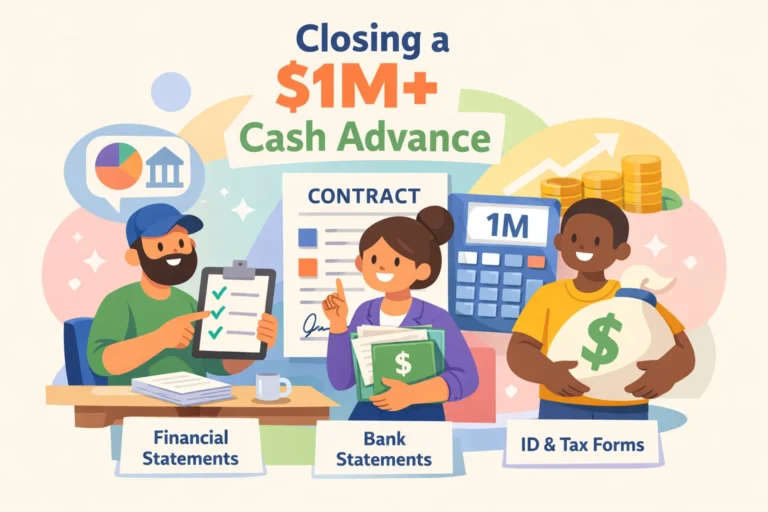
The baseline document package for any large MCA file includes 3-6 months of business bank statements (all pages, no gaps), 3-6 months of merchant or credit card processing statements, a government-issued photo ID for all owners holding 20% or more of the business, a voided business check to confirm banking details, and EIN documentation or business registration proof. Each document serves a specific verification function: bank statements verify cash flow and identify existing obligations; merchant statements verify card processing volume and consistency; IDs confirm ownership; the voided check confirms ACH details for funding.
For large files, “3-6 months” is not the minimum, it’s the floor. Underwriters on high-dollar applications want the longer end of that range. Submitting 6 months of statements rather than 3 gives them more data points to work with, which generally benefits the applicant when revenue trends are positive.
Additional documentation required for advances above $500K
Once you cross $500K, the core package expands. Business tax returns for the most recent 1-2 years are commonly requested to validate the revenue picture against a longer-term financial record. If bank statements show $400K/month in deposits but the tax return shows $800K in annual revenue, that inconsistency requires explanation. On very large files, underwriters may also request a basic balance sheet or income statement, accounts receivable aging reports if the business carries significant receivables, and articles of incorporation or operating agreements that establish ownership structure.
At the $1M+ level, the business longevity requirement typically increases as well. Where a standard MCA might accept 6 months in business, a seven-figure advance file usually needs to show at least 12-24 months of operating history. Longer history provides more data and demonstrates that the revenue model is durable rather than a short-term spike.
How to organize your file package to accelerate the underwriting review
Organization is not a courtesy, it directly affects how quickly a senior underwriter can move through your file. Label every document clearly with the business name, document type, and date range. Ensure bank statements are complete with no missing months and no missing pages within any month. If you’re submitting digitally through an ISO support line, compile everything into a single organized package rather than sending documents in 12 separate emails over three days.
Consider including a brief cover summary: the business name, the advance amount requested, a one-paragraph overview of the business model, the stated purpose of the advance, and a line-item disclosure of all existing debt obligations. That summary doesn’t replace any required document. It gives the underwriter a context frame that makes the review more efficient. A well-packaged, clean, complete submission can take days off the timeline at any quality direct funder.
How factor rates, holdback percentages, and payout schedules are determined
Most applicants accept MCA terms without fully understanding how those terms were calculated. Understanding the pricing structure helps you evaluate whether the advance makes financial sense for the business before signing, not after.
The risk inputs that determine your factor rate
MCA factor rates on large advances typically range from 1.10 to 1.50. Where your advance lands within that range depends on a combination of risk inputs: monthly revenue and consistency, credit card processing volume, time in business, owner credit score, industry risk classification, average transaction size, and the presence or absence of existing debt obligations. Funders don’t publish their exact scoring formulas, but these are the variables feeding into them.
Lower-risk profiles, consistent high revenue, clean bank statements, established operating history, no existing MCA stack, stronger credit, qualify for rates toward the 1.10-1.25 range. Higher-risk profiles push toward 1.35-1.50. On a $1M advance, the difference between a 1.15 factor rate and a 1.40 factor rate is $250,000 in total repayment cost. Understanding what’s driving your rate gives you the ability to address risk factors proactively before submission rather than accepting a high rate after the fact.
How holdback percentages are set and what they mean for cash flow
The holdback percentage is the daily or weekly portion of card sales deducted toward repayment. For large advances, holdback rates typically fall in the 10-15% range, calibrated against the business’s processing volume and the advance amount. A business processing $200K/month in card volume at a 10% holdback repays $20,000/month. At 15%, that’s $30,000/month against the same processing volume. The percentage is fixed at origination, but the actual dollar amount fluctuates because it’s tied to daily sales: stronger days mean higher repayments, slower days mean lower repayments.
That built-in flexibility is one of the genuine structural advantages of an MCA versus a fixed loan payment. During a slow month, repayments automatically decrease. During a strong month, they increase and the advance retires faster. For businesses with natural revenue cycles, this structure can be significantly more cash-flow-friendly than a fixed monthly payment obligation.
Estimating your real repayment timeline before you sign
The repayment timeline on an MCA is not fixed. It depends entirely on how much daily card volume you generate and how quickly your holdback percentage draws down the total payback amount. To estimate it, divide the total payback amount (advance amount multiplied by factor rate) by your estimated monthly holdback deduction. On a $500K advance at a 1.30 factor rate, your total payback is $650,000. At a $30,000/month holdback, you’re looking at roughly 22 months. At $50,000/month, you’re looking at 13 months.
The faster the repayment, the higher the effective annualized cost of the advance. That doesn’t make the advance a bad decision, but it does make it an informed one. Before signing a large advance, run this calculation. Know what the business is committing to in terms of monthly cash flow impact, and make sure the revenue supports it comfortably throughout the repayment window. You can also use a merchant cash advance calculator to validate scenarios and stress-test timelines.
The debt stack review: why existing obligations can sink your approval
The debt stack review is where more large advance files fail than most applicants expect. If a business is already carrying multiple MCA positions and the combined monthly outflows represent a significant portion of revenue, a new large advance may not get approved regardless of how clean the bank statements look otherwise. Funders are protecting their own repayment position, and they do that by ensuring the business isn’t already overextended before adding another obligation.
How underwriters calculate your capacity for a new position
The calculation looks at total monthly outflows on existing obligations: MCA holdbacks, term loan payments, equipment lease payments, and any other regular financial commitments appearing in the bank statements. That total gets compared against monthly gross revenue to determine what percentage of cash flow is already committed. When that percentage reaches 30-40%, the file moves into higher-risk territory. Above 50%, most funders will decline or significantly reduce the advance size.
This is why the advance size you request and the advance size you qualify for can diverge significantly when a business carries existing positions. The underwriter isn’t being arbitrary. They’re modeling whether the business can sustain another holdback deduction without going into cash flow distress, which would make repayment on the new advance impossible anyway.
Why undisclosed MCA stacking is the fastest path to denial
Underwriters use bank statement ACH analysis and UCC filing data to identify existing MCA positions, and these tools are effective. Regular weekly ACH debits at consistent amounts leave a clear signature in the statements. UCC filings are public record. If a business has three active MCA positions and the application only discloses one, that discrepancy gets detected in underwriting, and the file is flagged not just for denial but for fraud risk. Importantly, that flag follows the broker, not just the business owner.
Beyond the immediate denial, undisclosed stacking often violates the terms of existing MCA agreements, which typically contain anti-stacking covenants. A funder discovering an undisclosed new advance being taken out can call the entire existing balance due immediately. The legal and financial consequences of stacking fraud are serious. Full disclosure is the only practical solution. For more detail on typical MCA underwriting practices and how funders detect stacking, review underwriting resources before submission.
When a heavy debt stack doesn’t automatically disqualify you
Revenue strength can offset a significant existing debt stack when the math still works. A business generating $600K/month in gross revenue with $80K/month in existing MCA holdbacks is carrying a manageable 13% cash flow commitment. Adding another position at $40K/month in holdback brings that to roughly 20%, which aggressive direct funders can work with. The key is that the revenue base is large enough to absorb multiple positions comfortably.
Full transparency combined with strong revenue is the winning formula. When a debt stack is disclosed completely and the revenue demonstrates clear capacity to support a new position, funders with genuine underwriting appetite can make the deal work. A business that tries to hide its stack and gets declined anyway ends up worse off than one that disclosed everything and received a slightly smaller advance structured around its actual capacity.
Business performance indicators that underwriters score beyond the numbers
Bank statements and financial documents tell the quantitative story. Underwriters on large advance files also score qualitative performance indicators that don’t appear in any spreadsheet. These factors influence both the approval decision and the pricing terms.
Time in business and why 12+ months is the baseline for large advances
Standard MCA products often accept 6 months in business as a minimum. Large advance files operate under stricter standards. For advances above $500K, most funders want to see at least 12 months of operating history, and files in the $1M+ range often require 18-24 months or more. Longer operating history provides more revenue data points, demonstrates that the business model is durable through at least one full business cycle, and reduces the risk that the advance is being used to prop up a struggling young company rather than to accelerate a growing one.
A business younger than 12 months with strong early revenue is likely not the right candidate for a large advance at this stage, regardless of how impressive the numbers look. Building a verifiable track record first puts that business in a significantly stronger position when it does pursue high-dollar advance products.
Industry risk classification and how it affects approval odds
MCA funders maintain internal industry risk classifications that affect both approval appetite and pricing. Industries typically flagged as higher risk include construction, restaurants, trucking, retail, and certain healthcare segments. These classifications exist because businesses in these categories historically show more revenue volatility, higher chargeback rates, or structural risks that translate to higher default probabilities.
Being in a flagged industry doesn’t disqualify a large advance application. It does mean the file needs to work harder on supporting documentation. Strong, consistent bank statement history over 12+ months, clean merchant processing data, a solid owner credit profile, and a clean debt stack can offset an industry risk flag. Knowing upfront that your industry carries higher scrutiny helps you prepare a more compelling overall submission.
Owner credit score benchmarks for high-dollar MCA files
MCAs are fundamentally revenue-based products, which means owner credit score is a factor but not the primary one. For large advance files, a score below 500 with recent derogatory marks, late payments, collections, or bankruptcies, will raise questions and may affect the factor rate or advance size offered. A score above 600 is generally not a barrier, and scores in the 650+ range can support favorable pricing on large files even when other risk factors exist.
Credit events that underwriters specifically flag include recent bankruptcies (discharged within the last few years), active judgments or liens against the business or owner, and open collections. None of these automatically disqualify a large advance, but all of them need to be disclosed and ideally contextualized in the submission package. An undisclosed bankruptcy discovered mid-underwriting is a far bigger problem than a disclosed and resolved one noted upfront with a clear explanation.
Red flags that trigger denials, and how to get ahead of them
Most large advance denials are preventable. Not because the business isn’t fundable, but because the file arrives with problems a prepared broker or business owner could have addressed before submission. Below are the most common denial triggers and what you can actually do about them.
NSFs, overdrafts, and negative balance days: what they signal to underwriters
Frequent NSFs (non-sufficient funds events) or negative balance days within a 3-6 month bank statement window signal cash flow stress. For a large advance, this is a serious flag because the underwriter is modeling whether the business can handle a daily or weekly holdback deduction without going negative again. A business already struggling to maintain a positive daily balance before taking on another repayment obligation is a poor repayment risk.
The threshold that typically triggers concern is more than 2-3 negative balance days per month across the statement period. If those NSF events were tied to a specific one-time occurrence, a banking error, a delayed deposit, a discrete business disruption, a clear letter of explanation with supporting documentation can address the concern. Senior underwriters deal with complex business situations regularly and can work with a well-documented explanation. What they can’t work around is a pattern of unaddressed cash management problems with no context provided.
Revenue inconsistencies and statement discrepancies that kill large advance files
If the merchant processing statements show $200K/month in card volume but the bank statements only show $80K/month in deposits, that gap gets flagged immediately. Sometimes it’s legitimate: the business runs card volumes through a separate processor that deposits to a different account, or the merchant statement includes refunds and chargebacks that net out significantly in the actual deposit. Sometimes it’s not legitimate. Either way, unexplained discrepancies don’t survive large advance underwriting.
Reconcile your merchant and bank statements before you submit. Understand why any gaps exist and prepare a clear explanation with supporting documentation before the underwriter has to ask. An unexplained $120K/month discrepancy with no context is a denial trigger. The same discrepancy with a clear, documented explanation is a question that gets answered, and the file moves forward.
How to disclose problems proactively and still get the deal done
Senior underwriters on large advance files respect transparency. A well-written explanation letter addressing a revenue dip, tied to a verifiable event like a natural disaster, a major customer loss, a seasonal cycle, or a documented operational disruption, is far more effective than hoping the underwriter doesn’t notice. The latter strategy fails almost every time. The former gives the underwriter the context needed to make a fair risk assessment rather than assuming the worst.
For brokers submitting on behalf of clients, getting ahead of red flags is a core part of the job. Review the full statement package before submission. Identify every potential concern. Prepare a concise explanation for each one, and include those explanations in the initial package. More than any other single action, that step separates brokers who consistently close large advance files from those who watch them stall in underwriting.
How to package and submit a large MCA file for a fast decision
Everything covered in this guide comes down to execution: how you actually package and submit the file. A complete, organized, well-contextualized submission is the direct cause of a fast approval. An incomplete or piecemeal submission is the direct cause of delays, additional information requests, and stalled deals.
The pre-submission checklist for $500K+ MCA files
Before you submit a large advance file, confirm you have the following ready: 6 months of complete business bank statements with no missing months and no missing pages within any month; 6 months of merchant or credit card processing statements; a signed application with all fields complete; government-issued photo IDs for all owners holding 20% or more equity; a voided business check; EIN documentation or business license; and full disclosure of all existing MCA positions, loans, and recurring payment obligations.
For files above $500K, add to that list: the most recent 1-2 years of business tax returns; a basic balance sheet or income statement if available; accounts receivable aging if applicable; and a brief cover summary describing the business, the advance purpose, and the context for any notable items in the file. No gaps. No missing documents. No alterations or white-outs on any statement. Submit everything at once, not document by document over multiple days.
How to present context that helps underwriters say yes faster
A cover summary for a large advance file is not a formality. It’s a tool. A one-to-two page document that introduces the business, explains what the advance is being used for, describes the revenue trend over the past 6-12 months, identifies existing obligations, and flags any items needing context gives the underwriter a starting framework that makes the document review faster and more efficient. A submission that does this well signals immediately that the broker or business owner is organized, transparent, and understands what the underwriting process requires.
When submitting to a direct funder’s ISO support line, ask for any specific submission guidelines or formatting preferences they use. Funders like Greenvest operate with dedicated direct ISO support lines precisely to streamline this communication. A five-minute call before submission to understand what a specific funder’s underwriters prioritize on large files can prevent unnecessary back-and-forth that adds days to the timeline.
What to expect after submission and how to manage the process
After a complete file is submitted to a direct funder, the process typically moves through initial acknowledgment, document verification, possible requests for additional information, offer structuring, and funding. At most funders, the bottleneck on large files after initial submission is not the underwriter. It’s the broker’s or business owner’s responsiveness to information requests. Every hour of delay on your end is an hour your file is not progressing.
Stay accessible during the underwriting window. Respond to requests within the hour when possible. If you submitted a complete, well-organized file with a thorough cover summary, additional information requests should be minimal. At direct funders targeting 1-hour decision turnarounds on clean large files, like Greenvest Funding, your responsiveness post-submission is the primary variable controlling how quickly the deal closes. The underwriting side is ready to move. Make sure yours is too.
When institutional lenders decline large files, direct funders are built for this
Understanding why institutional lenders fail on large, complex working capital files helps you understand what to look for in a funding partner that actually closes these deals. The gap between institutional lending and direct alternative funding is not about rates or terms. It’s about underwriting philosophy and decision-making authority.
Why banks and institutional lenders systematically struggle with high-dollar working capital files
Bank underwriting models are built for businesses that fit a clean template: strong credit scores, long operating history, conservative debt-to-equity ratios, and industries the bank is comfortable with. When a large working capital file deviates from that template in any significant way, the bank’s formula produces a decline or a heavy reduction. The formula doesn’t accommodate judgment. It doesn’t account for a business in a flagged industry with a complex balance sheet that’s generating $600K/month in consistent, verifiable revenue.
Beyond the formula problem, institutional lenders move slowly. Large working capital decisions at banks often involve credit committees that meet weekly or bi-weekly, underwriting timelines that stretch into weeks, and approval processes requiring multiple sign-offs across departments. For a business owner who needs capital to close a time-sensitive opportunity or cover an urgent operational need, a 3-6 week bank process isn’t a solution. It’s a missed opportunity.
What separates a true direct funder from an institutional lender on complex deals
Direct funders own the capital and make underwriting decisions in-house. There is no external credit committee, no approval routing through a risk department in a different city. The underwriter reviewing your file has the authority to approve it, structure the terms, and move it to funding. That structure is what enables 1-hour decisions on large, complex files where banks are still scheduling their first internal meeting.
The other structural difference is underwriting philosophy. Direct funders apply judgment where banks apply formulas. A business with a significant debt stack but $500K/month in consistent revenue and a clear growth plan is a fundable deal to an experienced direct funder with genuine underwriting appetite. That same file often gets declined by a bank before anyone reads past the first page of the credit summary. Greenvest Funding works with deal sizes reaching $5M and beyond, a threshold institutional lenders rarely approach on working capital products, or exclude from consideration entirely.
What brokers and business owners should look for in a direct funder for large files
Not all direct funders are built the same. When evaluating where to submit a large advance file, the criteria that matter are: proven capacity to fund $500K and above with documented deal history at that level; a genuine 1-hour decision capability on clean, complete files; in-house senior underwriting staff with the authority to approve complex deals without external routing; a hard no-backdooring guarantee that protects broker-submitted deal relationships and commissions; and a direct ISO support line that provides real-time communication throughout the underwriting process.
Few funders meet all of those criteria simultaneously, but Greenvest Funding is built around exactly this combination. The underwriting appetite extends to files that other funders decline or cap out on. Same-day funding capability on approved large advances is not a conditional promise. The no-backdooring guarantee is non-negotiable: when a broker brings a deal to Greenvest, that client relationship and that commission stay with the broker. For ISOs and brokers handling high-volume large file submissions, that combination of speed, capacity, and relationship protection is what separates a funder you submit to once from a capital partner you build your business around.
The preparation game is the approval game
Getting approval for a large merchant cash advance is not about luck, and it’s not about knowing the right person. It’s about walking into the underwriting process with a complete, accurate, well-organized submission that addresses every question before the underwriter has to ask it. The businesses and brokers that consistently close large advance files are the ones that understand the underwriting playbook and execute against it every time.
Clean, complete documentation submitted all at once. Honest, full disclosure of all existing obligations. Strong and consistent revenue that supports the advance amount requested. Proactive explanation of any red flags before they become denial triggers. A submission package organized well enough that a senior underwriter can move through it efficiently. Every point of friction you remove from the underwriting process is time compressed and approval probability improved.
If you’re sitting on a $500K+ opportunity that’s stalled at an institutional lender, or if you’re a broker with a large file that keeps getting countered down at funders without the underwriting appetite to close it, the path forward is a direct funder built for exactly this. Greenvest Funding specializes in large, complex, high-dollar advance applications where institutional lenders stall and other funders run out of capacity. Reach out directly, submit a complete package, and get a decision in an hour. That’s what this category of funding is supposed to look like.