
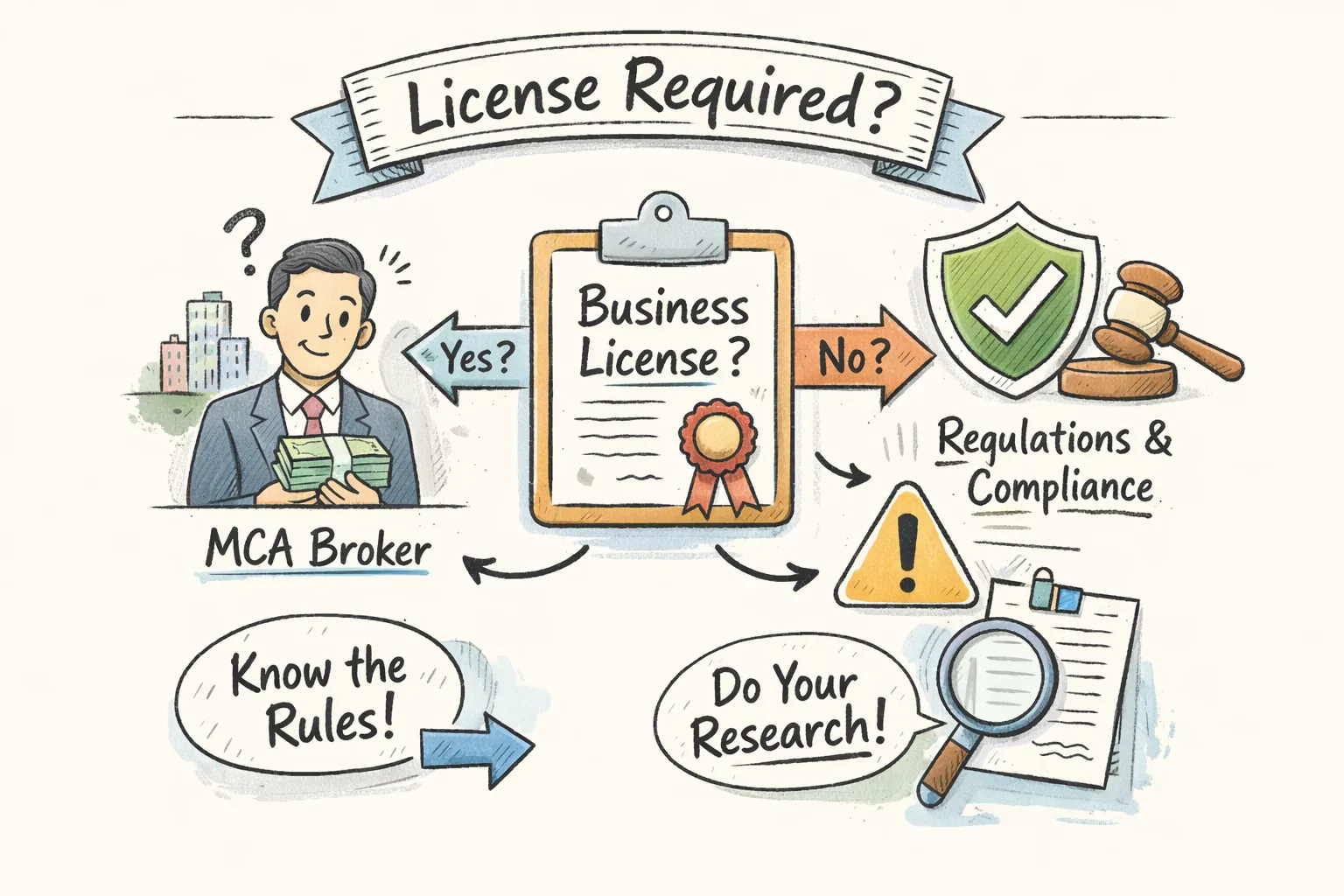
Do MCA Brokers Need a License? What You Must Know
The MCA broker license question is the first thing most new brokers Google, and one of the most misunderstood topics in the merchant cash advance space. The good news: merchant cash advance brokering is one of the least licensed financial activities in the country. Most brokers don’t need a traditional lender license at all.
But “least regulated” doesn’t mean “no requirements.” A handful of states have real registration or licensing rules, federal compliance obligations exist for every broker, and your disclosure practices matter more than most people realize. Get those wrong and licensing becomes the least of your problems.
This article breaks down exactly what’s required, state by state, so you can launch and operate with confidence. At Greenvest, we work with ISO broker partners across the country, and we’ve seen firsthand where brokers get tripped up. It’s rarely the license. It’s usually everything else.
The Honest Answer: Most MCA Brokers Don’t Need a Traditional License
Merchant cash advances are structured as the purchase of future receivables, not loans. That distinction matters enormously when it comes to licensing. Because MCAs aren’t classified as loans in most states, the standard lender licensing framework that governs banks and mortgage brokers simply doesn’t apply. This is why the barrier to entry in the MCA space has historically been low, and why thousands of brokers operate without anything beyond a basic business registration.
At the federal level, there is no dedicated MCA broker license. No federal agency issues one. What does exist are federal compliance rules that apply to any broker doing business at scale. If you’re arranging 100 or more covered MCA transactions annually, the CFPB’s Section 1071 Small Business Lending Data Rule applies, requiring you to collect and report demographic and pricing data. The FTC Act prohibits unfair or deceptive practices. The Gramm-Leach-Bliley Act limits how you obtain bank information. These aren’t licenses. They’re operating standards every broker must meet.
Before you submit a single deal, you’ll need a formal business entity (an LLC or S-Corp to protect personal assets and establish credibility with funders), an EIN from the IRS, and Errors and Omissions insurance, which most funders require before they’ll accept deal submissions. E&O coverage typically runs $300 to $1,000 annually for a small operation. None of these are licensing in the traditional sense, but skipping them creates real problems fast.
MCA Broker License Requirements by State
California is the exception, not the rule. Under the California Financing Law, any person who brokers commercial loans or MCA products for compensation must hold a Finance Lender/Broker License administered by the Department of Financial Protection and Innovation (DFPI). The application fee is $300, and you’ll need a $25,000 surety bond plus a minimum net worth of $25,000. There are limited exemptions for de minimis activity, but active brokers don’t qualify. Operating without this license in California is a misdemeanor, and the DFPI actively investigates and takes enforcement action. For detailed application steps and requirements, consult the California Financing Law FAQs provided by the DFPI.
The California application process runs through the Nationwide Multistate Licensing System (NMLS). You’ll submit a business plan, financial statements, background disclosures, and fingerprints for all principals. Historical processing times run three to six months, so if you’re planning to broker deals to California merchants, start early, don’t wait until you have a merchant ready to sign.
Virginia, Utah, and Missouri each have registration-based requirements that catch many brokers off guard. Virginia’s Sales-Based Financing Providers Act (effective July 2022) requires both MCA providers and brokers to register with the State Corporation Commission. The definition is broad: anyone who obtains or offers financing for compensation is covered. Utah’s Commercial Financing Registration and Disclosure Act, effective January 2023, requires registration with the Department of Financial Institutions for deals involving Utah-based merchants. Missouri added broker registration requirements in early 2025 for anyone handling five or more MCA transactions annually.
New York doesn’t require a merchant cash advance broker license, but it does require strict compliance with the Commercial Finance Disclosure Law. Brokers must disclose their compensation on offer summaries, maintain records for three years, and file annual reports each April. The disclosure requirements carry real weight: non-compliance exposes brokers to enforcement from the New York Department of Financial Services and state attorney general, and funders routinely audit submissions for disclosure gaps before accepting them. See the text of 23 NYCRR Part 600 (New York’s Commercial Finance Disclosure Law) for full details.
Texas, New Jersey, and North Carolina each have bills advancing that would introduce broker registration requirements. Texas House Bill 700 and Senate Bill 2677 would require registration with the Office of Consumer Credit Commissioner before brokering any MCAs to Texas-based merchants. Louisiana added revenue-based financing disclosures effective August 2025. The regulatory landscape is moving faster than it ever has, and states that require nothing today may require registration by next year.
What Every Broker Needs Regardless of Where They Operate
A properly formed business entity is non-negotiable everywhere. Beyond the LLC and EIN, most funders require proof of E&O insurance before approving a broker for deal submissions. This isn’t a legal mandate in most states; it’s a funder-side requirement that effectively functions as one. Some funders also conduct background checks and request executed ISO agreements before the relationship goes live. Treat funder onboarding requirements as a compliance floor, not a ceiling. For a quick sense of typical marketplace pricing and coverage considerations, see common Errors and Omissions insurance costs.
Three federal frameworks apply to all MCA brokers regardless of volume or geography. The FTC Act prohibits deceptive or unfair practices in marketing and deal presentation. The GLBA prohibits misrepresenting your identity to obtain financial information from any institution. For brokers hitting the 100-deal threshold, Section 1071 reporting kicks in, with tiered start dates running from 2026 through 2027 depending on annual transaction volume. Understanding these isn’t optional, they’re the baseline for operating professionally in this space.
One more item belongs in your setup checklist: UCC filing awareness. When you submit deals to funders who take a first or second position, those positions are recorded through UCC-1 filings against the merchant’s receivables. You don’t file them, but you need to understand what they mean for deal stacking, second-position submissions, and merchant eligibility. Brokers who don’t understand lien positions end up submitting deals that were never going to fund.
Disclosures and Contracts: What Funders and Merchants Require from You
Several states now require specific disclosures before a merchant commits to an offer. The core elements, required in New York and California and increasingly expected everywhere else, include the total advance amount, total payback amount, factor rate, estimated APR, all fees including broker compensation, and payment frequency. These must be delivered in writing before the merchant signs anything. Timestamps and acknowledgment records matter because gaps in your documentation create liability on both sides of the transaction.
New York’s Commercial Finance Disclosure Law is the most detailed framework currently in effect. Under 23 NYCRR Part 600, offer summaries must be formatted in Times New Roman font with precise numerical expressions, and the recipient must sign before you can communicate a binding offer. The broker’s compensation must be separately disclosed in writing, showing how and by whom it’s paid. This isn’t a suggestion, New York’s Department of Financial Services and attorney general treat non-compliant disclosures as grounds for enforcement action.
The broker’s compensation structure needs to be explicitly stated in the offer summary and sometimes in the contract itself. Sample language that regulators expect reads something like: “Broker [Name] receives [X]% commission from the funder. No additional fees are charged to the merchant.” The contract should also cover the advance amount, daily or weekly deduction percentage, estimated repayment term, reconciliation rights, and default provisions. Multi-state brokers need customized disclosure forms for each transaction, because a single template doesn’t satisfy varying state requirements simultaneously. Attorney-reviewed templates are worth the investment if you’re submitting deals across multiple states.
Which Agencies Are Watching the MCA Broker Space
The California DFPI is the most active state regulator in this space. It investigates complaints, takes enforcement action against non-compliant providers and brokers, and issues corrective orders with real financial consequences. Virginia’s Bureau of Financial Institutions enforces the Sales-Based Financing Providers Act. Utah’s Department of Financial Institutions handles registration enforcement for deals involving Utah merchants. The agency watching you depends entirely on where your merchants are located, not where your business is registered.
State attorney general offices round out the enforcement picture. New York’s attorney general pursues cases involving deceptive practices, fraudulent filings, and unfair conduct under the FAIR Act standards. California’s DFPI often works alongside the state AG on larger enforcement actions. Secretary of state offices handle business registration complaints. The practical implication: if a merchant in any regulated state files a complaint against you, the relevant state agency will look at your disclosure records first. Clean documentation is your primary defense.
At the federal level, the FTC is the primary enforcer for unfair and deceptive MCA practices. The CFPB’s jurisdiction in the MCA space is limited but expanding, particularly around the Section 1071 reporting rule. Neither agency offers individual enforcement pathways for merchants, but both have authority to pursue systemic misconduct by brokers operating at scale. If you’re doing volume and your practices have been sloppy, federal attention is a real possibility.
MCA Broker Licensing Compliance Is Only Half the Picture
Getting your business formed, understanding your state’s rules, and setting up proper disclosures puts you in a legally sound position. But long-term legitimacy in this industry depends on something most merchant cash advance broker licensing articles don’t mention: the funder you work with. A broker’s compliance record is only as clean as the deals they submit and the underwriting decisions on the other end. If your funder operates with opaque criteria, inconsistent approval standards, or untracked commission structures, your exposure as a broker grows regardless of how clean your paperwork is.
Working with a direct funder that has transparent underwriting criteria, defined deal structures, and clear commission documentation isn’t just operationally efficient, it’s a compliance asset. At Greenvest, we share underwriting criteria with broker partners upfront, provide documented commission structures on every deal, and require proper disclosure completion before submission. We fund $100K to $5M in working capital directly, with 1-hour credit decisions and no broker chains obscuring the terms. For brokers building a compliant, scalable operation, that funder relationship functions as a compliance layer that no commercial lending broker license or state registration can fully replace.
What to Do Before You Submit Your First Deal
The MCA broker license question has a straightforward answer for most of the country: you don’t need one. You need a properly formed business, an EIN, E&O insurance, and a clear understanding of the disclosure rules in the states where your merchants operate. If you’re in California, Virginia, Utah, or Missouri, add the relevant registration to that list. If you’re in Texas, start tracking the pending legislation now.
The more important question isn’t whether you have a license. It’s whether you’re operating in a way that holds up to scrutiny. Clean disclosures, documented commissions, compliant contracts, and a funder relationship built on transparency are what actually protect your business long term. Get those right from day one and the MCA broker licensing question becomes the easy part of running a compliant operation.
If you’re ready to build that foundation, Greenvest offers broker partners transparent underwriting, a free CRM sub-account, ISO training that covers disclosure compliance and deal packaging, and a structured onboarding path that addresses the compliance basics from day one. The brokers who scale fastest aren’t the ones who found a licensing shortcut, they’re the ones who built clean operations early. If you want help sorting through your mca broker license obligations and compliance steps, consult an attorney or compliance specialist, and consider a funder partner who makes that process easier from the start.