How Much Do ISO Brokers Make in Working Capital?
A top-producing ISO broker clearing $250,000 or more per year is not rare in working capital. Neither is someone doing everything right on paper but stuck at $40,000, working with the wrong funders, packaging deals sloppily, or leaving commission structure details unread. If you want to understand what an ISO broker does and how much that work realistically pays at different stages of output, this breakdown is built around real commission math, not career-guide vagueness.
At Greenvest, a direct funder in the working capital space, broker partners see firsthand how deal volume translates to commission income. When you have transparent buy rates, direct access to capital, and a working system behind you, the math gets a lot clearer. The numbers below reflect what that looks like in practice.
What an ISO broker actually does every day
An ISO broker sits between small and mid-sized businesses that need working capital and the funders who provide it. The role is more operational than most people expect. You’re not just making calls and shaking hands, you’re running a process from merchant qualification through to funded status, and the quality of that process directly determines your commission outcomes.
Sourcing merchants and qualifying deals
Working capital brokers identify business owners who need capital, typically through outbound outreach, referral networks, or inbound leads. Qualification in working capital is revenue-first, not credit-score-first. Bank statements and cash flow consistency are what underwriters actually look at. A merchant with healthy average monthly deposits and predictable cash flow is a fundable deal, though fundability thresholds vary by funder and merchant risk profile. You’re assessing whether the business can sustain daily or weekly repayments before you spend time packaging the file.
Deal packaging and document collection
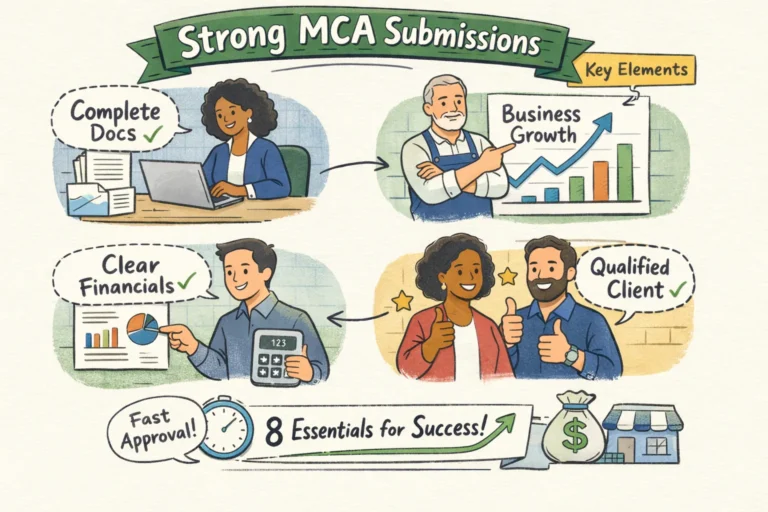
Once a merchant qualifies, the broker collects the documents that make up the submission: three to six months of business bank statements, a signed working capital application, government-issued ID for all owners above 20% equity, a voided check, and sometimes business formation documents or a license. A clean, complete file moves faster through underwriting and reduces the back-and-forth that delays funding and risks losing the merchant’s attention. Sloppy submissions cost you deals.
From submission to funded: the broker’s role in closing
After submission, the broker manages the file through offer review, helps the merchant compare terms, and facilitates the final contract signing. Funding typically happens within 24 to 48 hours once paperwork is clean. Your job ends at funding, not at underwriting. You prepare and submit the file; the funder evaluates the risk. Following up aggressively after funding is how you build renewal business, which becomes a significant income layer over time.
How ISO broker commissions are actually structured
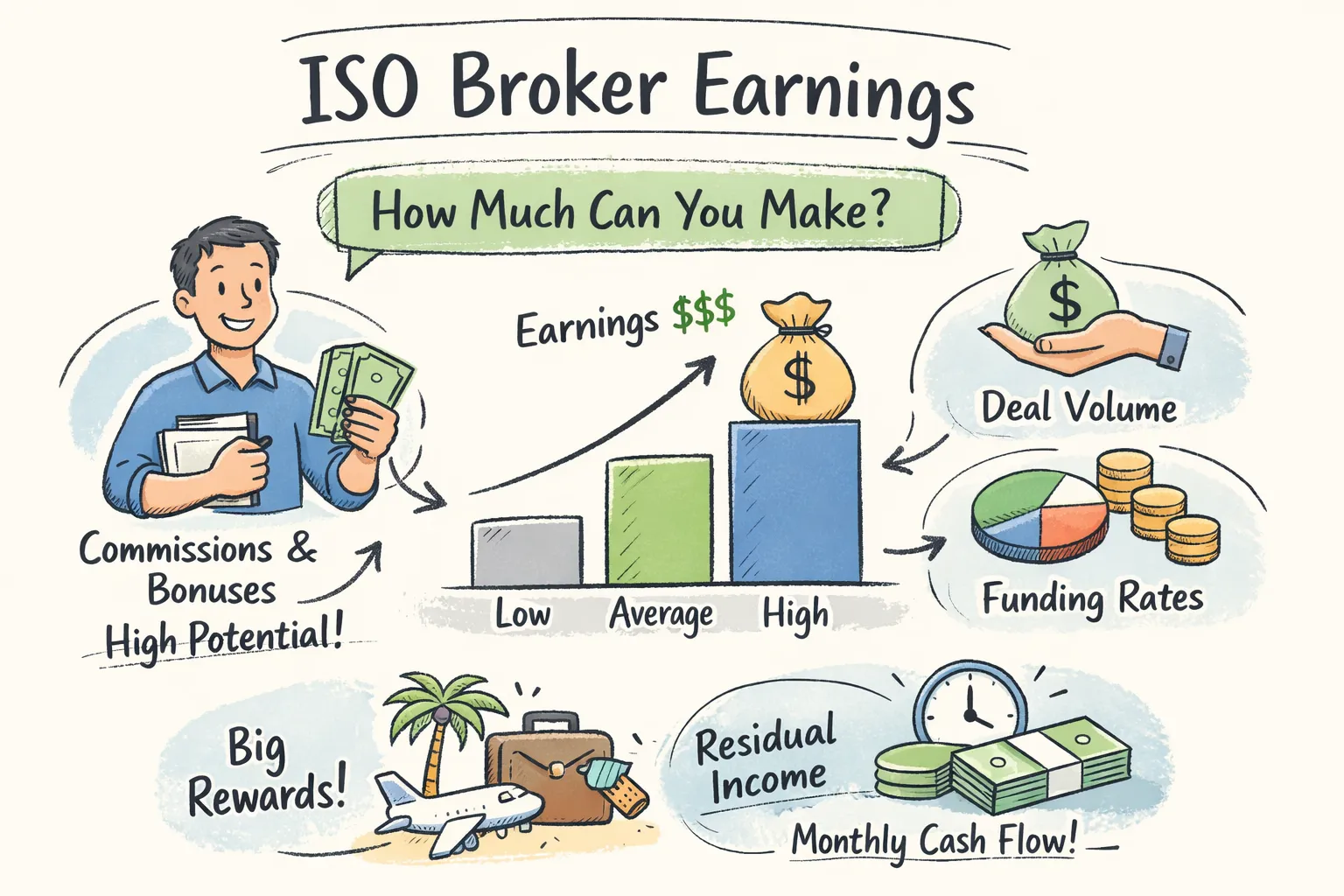
ISO compensation comes down to one core mechanic: the spread between what the funder charges (the buy rate) and what the merchant agrees to (the sell rate). That spread, expressed as a percentage of the funded amount, is your upfront commission. The details around renewals, volume bonuses, and contract terms determine how much of it you actually keep.
The factor rate spread and upfront splits
Every MCA deal has a buy rate and a sell rate. The funder sets the buy rate, which is the base cost of capital. You set the sell rate, which is what the merchant agrees to. If the buy rate is 1.25 and you sell at 1.30, the 0.05 spread on the funded amount is your commission. On a $50,000 deal, that’s $2,500. On a $200,000 deal with the same spread, that’s $10,000. Standard upfront commissions land between 5% and 15% of the funded amount, with larger deals and established relationships typically commanding higher rates.
Residuals, renewals, and volume bonuses
Residual income in MCA has shrunk significantly as ACH-based repayment reduced reliance on processing splits. The real repeat income comes from renewal commissions, which run 2% to 5% when a merchant refinances or renews an advance. These renewals require minimal reselling effort if you maintained the relationship. Volume bonuses are also a factor: at certain funded volume thresholds, often around $200,000 per month, though exact figures vary by funder, brokers can unlock additional points on total commissions. Those bonuses compound quickly at scale, so it’s worth confirming the specific tiers in your ISO agreement before building projections around them.
Realistic earnings at different deal volumes
MCA broker income is genuinely wide-ranging, and it maps almost directly to deal volume and average deal size. Here’s what that looks like across experience levels.
Entry-level and mid-tier income: what the numbers show
Reported median income for independent working capital brokers falls roughly between $60,000 and $96,000 annually, with entry-level producers typically in the $40,000 to $80,000 range. A broker closing two $75,000 deals per month at a 10% commission earns $15,000 per month, or $180,000 per year. Most new brokers don’t hit that volume immediately, which is why the $40,000 to $60,000 range is common in year one. The limiting factor is almost always deal volume, not commission rate. For broader market salary context, see the ISO salary data on ZipRecruiter, which tracks compensation trends for similar roles.
Focusing on larger deal sizes, say, $150,000 to $300,000, can accelerate income faster than chasing higher percentage rates on smaller files. Keep in mind that larger deals may carry slightly lower commission points and often require more documentation, so the trade-off is worth understanding before you target a specific niche.
What high-volume producers actually earn
The top quartile of brokers earns $120,000 to $157,000 annually, with the top 10% clearing $250,000 to $500,000 or more. A broker running $500,000 per month in funded volume at an average 8% commission pulls $40,000 monthly. Renewals layer on top of that, compounding annual income without requiring full sales cycles on existing merchants. That’s the model: build the active book, then let renewals raise the floor.
Modeling your own income before you submit a deal
Greenvest offers a commission calculator for broker partners that lets you input deal size, expected monthly volume, and commission rate assumptions to project monthly and quarterly earnings before building a pipeline. This removes the guesswork from income planning and gives you a concrete target to work backward from. If you know you need $15,000 per month to replace your current income, you can calculate exactly how many deals at what average size get you there, which is a more useful starting point than vague annual salary ranges.
Contract terms that quietly reduce what you take home
Most discussions of ISO broker income focus entirely on commission rates and skip the contract terms that determine how much of that commission you actually keep. These clauses are where income surprises happen, and not pleasant ones.
Clawback clauses and early default risk
Clawback clauses allow funders to recover your commission if a merchant defaults early, typically within 30 to 90 days of funding. On a $100,000 deal where you earned $10,000 in commission, a default in week three means the funder deducts that $10,000 from future payouts, or demands direct repayment, depending on the agreement terms. High loss ratios from a single ISO can trigger a full cutoff from the funder. The best protection is better qualification upfront: verify cash flow genuinely, check for existing advances, and don’t chase marginal deals just to hit volume. For a helpful discussion of why it’s important to review your ISO agreement closely, see this Debanked analysis of ISO agreements.
Stacking restrictions and professional service fee limits
Stacking prohibitions void your future commissions on a merchant if you introduce them to a competing funder while their current MCA is still active. Professional service fee caps, typically set at 5% to 10% of the funded amount by most funders, exist as a ceiling on what you can charge merchants directly. Exceeding that cap risks termination, withheld commissions, or full clawback on the deal. Read every ISO agreement carefully before signing with any funder. The clauses that reduce your pay are rarely highlighted in the onboarding call.
How to get started and actually scale as an ISO broker
Getting licensed and getting moving are two different problems. The compliance side is more straightforward than most people assume. The infrastructure side is where most brokers stall.
Licensing and compliance basics
No single federal license exists for working capital brokers in the United States. Requirements are determined at the state level and vary significantly. Some states, including California, require a license or registration to operate as a working capital broker. Others impose disclosure requirements or registration as a sales finance company. Universally, you need an EIN from the IRS and basic business entity formation. If your work involves card-based processing relationships, Visa and Mastercard registration adds a $10,000 first-year fee and $5,000 annually per processor. Some states also require surety bonds, typically in the $75,000 to $250,000 range. Check with your state’s department of financial institutions before launching.
The infrastructure that separates growing brokers from stagnant ones
Compliance gets you legal. Infrastructure is what enables you to scale toward high six-figure earnings, the kind top performers consistently reach. What separates brokers who break through the median from those who don’t usually comes down to a few concrete advantages: a direct funder relationship with transparent underwriting criteria, a CRM to manage pipeline and follow-up at volume, and access to experienced people who can tell them when a deal is worth packaging versus when to pass. Working through broker chains introduces commission dilution, decision delays, and opacity around why deals get declined. A direct relationship removes all three.
Greenvest is built specifically for brokers who want that direct access. Partner brokers get a free GoHighLevel CRM sub-account for pipeline management and client outreach, access to the Funded Founder community for live Q&A and deal packaging training, and transparent underwriting criteria shared upfront so you know what a fundable file looks like before you submit. Compare how funders describe their own ISO programs when you evaluate partner options, the level of transparency varies dramatically and it shows up in your conversion and retention rates.
Your next move as an ISO broker
The ISO broker role is operational and relationship-driven. Your income reflects your output directly, which is both the appeal and the accountability of the job. The range is real: $40,000 for someone submitting one or two deals a month without a system, and $300,000 or more for someone running a high-volume operation with the right funder partnerships, a real pipeline tool, and consistent deal quality.
The clearest starting point is knowing your numbers before you scale. Use Greenvest’s commission calculator to model income based on your actual target deal size and volume, it shows you exactly how many funded deals at a given size and commission rate you need to hit a monthly income target. From there, the path is straightforward: qualify better merchants, package cleaner files, and build with a direct funder who shows you the underwriting criteria before you submit your first deal.
If you’re ready to see what your deal volume could produce, visit the Greenvest partner program page and start with the commission calculator. You’ll walk away with a specific monthly deal target, not a salary range from a career guide.
Frequently asked questions about what an ISO broker does and how much they can earn
What does an ISO broker do in working capital?
An ISO broker acts as the intermediary between small businesses that need working capital and the funders who provide it. Day-to-day, that means sourcing and qualifying merchants, collecting documents, packaging submissions, and managing the deal through funding. The role is more process-driven than most people expect, and your commission income reflects the quality of that process directly.
How much can an ISO broker earn in working capital?
Income ranges from roughly $40,000 per year for brokers closing a handful of deals monthly, up to $300,000 or more for high-volume producers with strong funder relationships and consistent deal flow. The median falls somewhere between $60,000 and $96,000. Deal volume and average deal size are the two biggest drivers, commission rate matters, but it’s secondary to throughput.
What is a factoring broker versus an MCA broker?
A factoring broker arranges accounts receivable financing, where a funder purchases unpaid invoices at a discount. An MCA broker arranges merchant cash advances, which are repaid through a fixed percentage of daily or weekly revenue. Both fall under the broader category of alternative business lending, but the products, underwriting criteria, and merchant profiles differ meaningfully. If you’re exploring how to enter factoring specifically, Capstone Trade’s guide on becoming a factoring broker or ISO offers a practical starting point.
What are broker splits and recapture in working capital?
Broker splits refer to how commission is divided when multiple parties are involved in a deal, for example, when a broker works through an ISO aggregator rather than directly with a funder. Recapture (similar to a clawback) is when the funder recoups previously paid commission due to early default. Both reduce take-home income and are worth understanding before signing any ISO agreement.