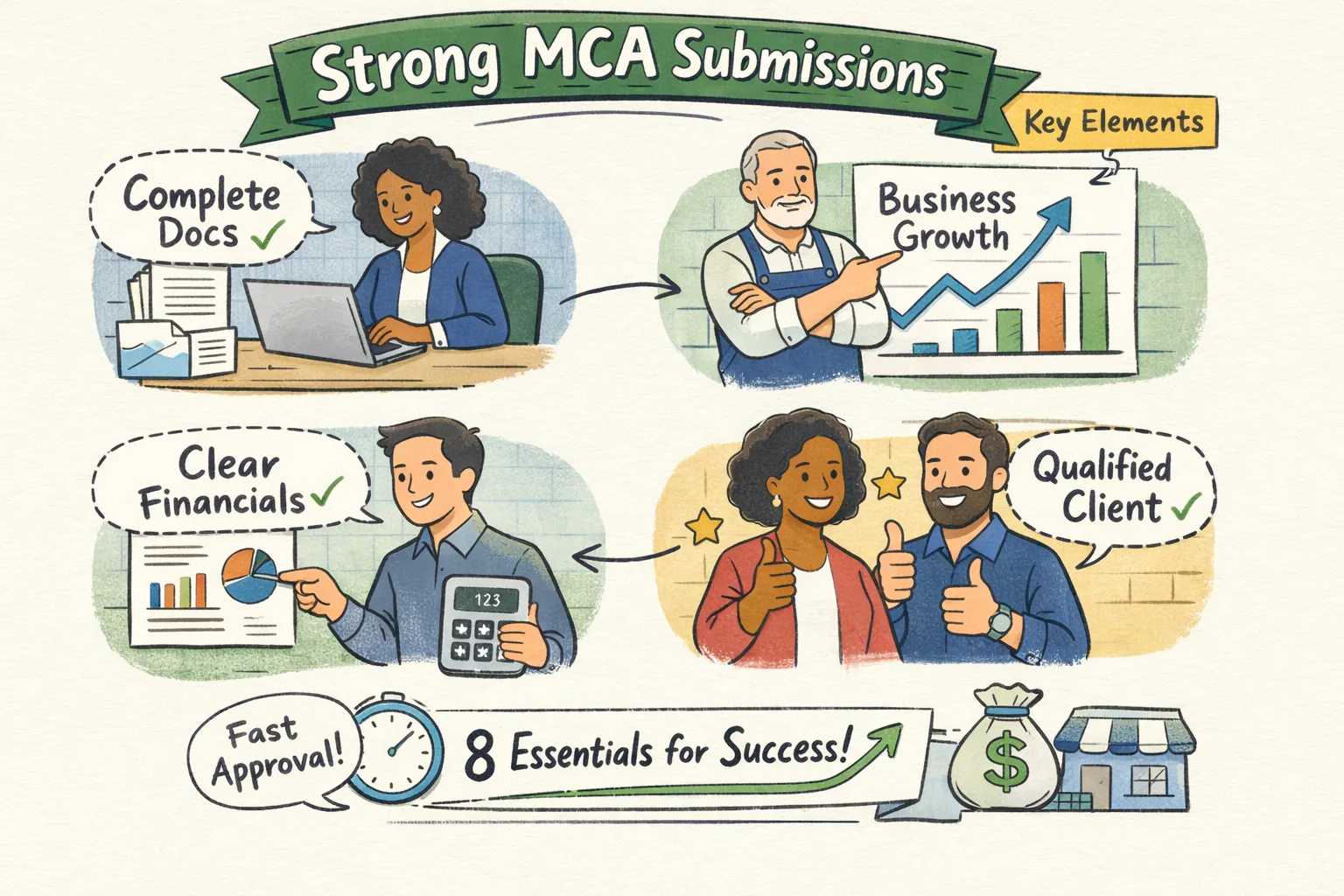
What Makes a Strong MCA Deal Submission: 8 Key Elements
What makes a strong MCA deal submission? It starts long before you hit send. Merchants get declined every day who should have been funded. The deal was there. The revenue was real. The business qualified on paper. What killed it was the package. A disorganized, incomplete, or poorly framed submission lands on an underwriter’s desk and gets shelved in under a minute, not because the merchant wasn’t creditworthy, but because the broker didn’t build the file correctly.
A strong MCA deal submission isn’t just about gathering the right documents. It’s about knowing what underwriters extract from those documents, how information gets interpreted under time pressure, and what signals cause a file to get flagged before anyone reads past page one. Most brokers treat packaging as an administrative task. The ones closing more deals treat it as a strategy, and the results show in their approval rates. This MCA submission checklist breaks down eight elements that separate a funder-ready deal package from one that gets declined or delayed.
At Greenvest, we share underwriting criteria with our ISO broker partners from day one. That means brokers know exactly what qualifies, what disqualifies, and how to build a file before they ever submit. The logic below reflects the same framework our underwriting team uses on every deal.
Why the package gets judged before the merchant does
Underwriters review dozens of files every day. They don’t have time to chase down missing pages, decode inconsistent formatting, or interpret documents that weren’t organized for them. Within the first 60 seconds of opening a submission, they’ve already formed an impression of the file and, by extension, the broker who sent it.
How underwriters make initial risk decisions in the first 60 seconds
The first pass isn’t about deep analysis. It’s about completeness, consistency, and clarity. An underwriter scanning a new file wants to confirm that everything required is present, that the numbers don’t contradict each other, and that the package is structured in a logical order. If something looks off immediately, a missing page in the bank statements or a business name that doesn’t match the ID, it creates doubt. That doubt doesn’t get resolved quickly. The file gets set aside while the underwriter moves to one that doesn’t raise questions.
Why submission quality reflects on the broker, not just the merchant
Funders track which brokers send clean files and which ones send problems. ISO partners who consistently submit well-packaged, pre-screened deals build credibility with underwriting teams. They get faster reviews, better communication, and more flexibility on borderline files. Brokers who consistently send incomplete or poorly assembled packages lose priority in the queue. The relationship deteriorates, and so do their approval rates. Submission quality is a competitive advantage most brokers overlook.
What makes a strong MCA deal submission: core documents
Before any analysis happens, the file has to be complete. Incomplete submissions are frequently declined or deprioritized, underwriters have other files to move to. Here are the non-negotiable documents every deal package needs, regardless of deal size or industry.
Business bank statements: the centerpiece of every submission
Three to six months of complete, unaltered business bank statements are the primary underwriting tool in merchant cash advance financing. Funders use them to verify deposit volume, assess cash flow consistency, identify NSF events, and determine whether the merchant can sustain daily or weekly holdback payments. Most funders in the MCA market expect a minimum of $10,000 in average monthly deposits as a general benchmark, though thresholds vary by funder and program. Larger advance requests or newer businesses typically require six months of statements to establish a reliable revenue pattern. The statements must be complete: every page, every transaction, no highlighting, no handwritten additions. Missing pages create gaps in the analysis. Altered documents are treated as fraud flags.
Identity, ownership, and account verification documents
Government-issued photo ID is required for every owner holding 20% or more of the business. This is both a compliance requirement and an identity confirmation step. Alongside ID, funders need a voided business check for ACH setup and bank account verification. EIN documentation and business formation proof, which may be articles of incorporation, a business license, or state registration depending on entity type, confirm that the business is legally established and operating. These documents aren’t optional. Without them, no underwriter can validate that the entity is real or that the signatory has authority to enter a funding agreement.
What underwriters extract from bank statements
Bank statements don’t just show revenue. They tell a complete story about how a business manages money, handles obligations, and whether it has the cash flow to sustain a new holdback. Underwriters are trained to extract specific signals from these documents, and brokers who understand that logic can review files themselves before submitting.
Average daily balance and what it signals about repayment capacity
Average daily balance (ADB) is one of the primary metrics underwriters use to evaluate repayment risk. It’s not enough for a merchant to show strong gross deposits if the account is frequently depleted between deposit cycles. A low or volatile ADB signals tight cash flow and raises questions about whether the merchant can sustain holdback withdrawals on slow days. Underwriters compare the proposed holdback amount directly against the merchant’s ADB to estimate repayment stress. A business showing $80,000 in monthly deposits but maintaining an ADB of $1,200 presents a very different risk profile than one maintaining $15,000.
Deposit consistency and revenue quality
Consistent deposit patterns indicate operational stability. Underwriters examine month-over-month deposit variation: a revenue swing greater than 20% between months is generally treated as a red flag in MCA underwriting. Beyond volume, they strip out non-true revenue from total deposits, including wire transfers from related entities, intercompany transfers, loan proceeds, and personal deposits. What remains after that cleanup is qualified revenue, the actual figure used for advance sizing and holdback calculations. Gross deposits and qualified revenue are not the same number, and brokers who don’t understand this distinction often overestimate what a merchant will qualify for.
NSF history, overdrafts, and what they tell the underwriter
NSF events are among the highest-weighted risk indicators in MCA underwriting. A commonly cited industry benchmark is zero to five NSF events in a 90-day statement window, though grading thresholds vary by funder. Even occasional NSFs raise concern; frequent ones push a file into high-risk or outright decline territory. Underwriters track the number of negative balance days, insufficient funds fees, and overdraft reversals across the full statement period. A merchant with three or more NSF events in 90 days will often be assigned a lower paper grade, meaning tighter terms, higher factor rates, or no offer at all, depending on the funder’s risk model. Brokers who screen for NSF frequency before submitting avoid spending time on files with structural cash flow problems.
Time in business and revenue benchmarks that funders actually use
Vague guidance like “established business preferred” doesn’t help you build a file. Here are the thresholds most MCA funders apply and how they shift based on deal size.
Why minimum time in business requirements exist and where they sit
The standard minimum time in business for MCA approval is commonly six months, though the range across funders runs from three months on the low end to 12 months for more selective programs. The threshold exists because a business with less than six months of operating history doesn’t have enough statement data to establish reliable revenue patterns. For larger advances, typically $250,000 and above, most funders require 12 months or more in business. At that deal size, the funder needs to see normalized revenue through seasonal cycles, not just a promising few months. Newer businesses that fall short on time in business can sometimes compensate with six months of statements instead of three, but the scrutiny is higher.
Revenue trends versus revenue totals: what underwriters weigh more
A merchant averaging $120,000 per month in deposits but declining 8% month over month is a more complicated file than a merchant averaging $80,000 per month and growing 5% consistently. Underwriters pay attention to trajectory. Growth signals expanding operations and improving repayment capacity. Decline signals the opposite, it raises questions about whether the business can sustain holdbacks on top of whatever is causing the revenue drop. Brokers who understand this logic can make better decisions about whether a file is ready to submit or whether the merchant needs another 60 to 90 days before the timing is right.
Red flags that kill deals before underwriters finish reading
These are the issues that cause declines before an underwriter reaches the end of the file. Run this as a pre-submission audit on every MCA deal package before you send it.
MCA stacking and existing debt load: a leading decline trigger
Stacking, a merchant carrying multiple active MCAs or frequent loan repayments, is one of the most common causes of MCA declines. Underwriters identify stacking directly from bank statement outflows. Daily or weekly withdrawals that match MCA payment patterns show up clearly in the transaction history, regardless of what the merchant disclosed on the application. When combined daily obligations exceed roughly 20% of gross revenue, most funders won’t approve a new position without consolidation. Before submitting any file, calculate the merchant’s existing debt service coverage: divide monthly net cash flow by total monthly debt obligations. A debt service coverage ratio (DSCR) below 1.25 is marginal. Below 1.0 means the merchant can’t cover current payments, let alone new ones. Disclose existing positions honestly, hiding them doesn’t work, and it damages your relationship with the funder.
Cash flow inconsistencies and document manipulation signals
Underwriters are trained to spot altered bank statements. Sudden deposit spikes that don’t align with stated business type, missing pages in the middle of a statement period, inconsistent bank headers across months, and totals that don’t add up across documents all trigger fraud flags. These inconsistencies don’t have to be intentional to cause damage. Even a merchant who uses PDF editing to highlight figures, without changing them, can create the appearance of manipulation. Cross-referencing EIN, business address, and transaction data is standard practice. If anything doesn’t match, the file gets flagged. Review for consistency before submitting, and if something looks off, address it with a cover note rather than hoping it gets overlooked.
Gaps in documentation and incomplete applications
An incomplete submission is effectively a soft decline. Underwriters dealing with a full queue will often move to cleaner files rather than chase brokers for missing items. Missing bank statement pages, a missing co-owner ID, or a missing voided check all add unnecessary friction. The standard for “complete” means every page of every statement is present, IDs are provided for all owners with 20% or more stake, and every field on the application is filled in accurately. Verify this before you hit send. A five-minute completeness check eliminates the most avoidable cause of delay.
Supporting documents that strengthen approval odds
Some documents aren’t required but can meaningfully strengthen a borderline file, particularly for larger advance requests. Including them proactively reduces back-and-forth and signals to the funder that you’ve already done the work.
Processor statements and POS reports: when sales data seals the deal
Merchant processor statements and POS reports show card-based revenue separately from total bank deposits. For retail merchants, restaurants, or any business with significant card transaction volume, these documents allow underwriters to verify deposit consistency from a second angle. If bank statements alone look thin or volatile, processor data can provide corroborating evidence of actual sales activity. They’re especially useful when the merchant deposits card revenue in batches rather than daily, which can make bank statement patterns appear less consistent than the underlying business actually is.
Business tax returns and P&L snapshots: for larger or more complex deals
Tax returns typically become relevant for larger advances, newer businesses without strong bank statement history, or merchants in higher-risk industries. One to two years of business tax returns give underwriters a longer view of financial performance beyond what 90 days of statements can show. A simplified one-page P&L snapshot, even a basic summary of monthly revenue, operating costs, and net profit, can reduce underwriter hesitation on borderline files. It signals that the merchant has visibility into their own finances, which matters. For straightforward smaller deals with clean bank statements, neither document is usually required, but having them available speeds up the review if questions arise.
How to format your MCA deal submission for faster decisions
This is where most brokers leave time on the table. The content of the file matters. So does how it’s organized. Underwriters shouldn’t have to work to find what they need.
File naming, folder structure, and submission organization
Use a consistent naming format for every document: MerchantName_AccountNumber_Date_DocumentType.pdf. This prevents confusion when an underwriter is managing multiple files from multiple brokers at once. Organize all documents in a ZIP archive with a clear name following the same convention, for example, ABCRestaurant_789012_20260416_Submission.zip. The internal order matters: cover sheet first, then bank statements in chronological order, then ID documents, then supporting materials. A logical structure means the underwriter can navigate the file without asking where anything is.
The one-page cover sheet: your submission’s first impression
A strong cover sheet communicates key deal metrics before the underwriter opens a single bank statement. Include the merchant’s business name, entity type, time in business, industry, requested advance amount, average monthly deposits, average daily balance, current debt positions, DSCR estimate, and a two or three sentence description of the business. The goal is to let the underwriter assess viability in under 30 seconds. A well-built cover sheet tells the underwriter you’ve already done the analysis, which builds credibility and accelerates the review. A missing or poorly constructed cover sheet signals the opposite.
Communication habits that shorten turnaround time
Proactive, concise communication during the review process moves files faster than reactive follow-up. If there’s a known issue with the file, disclose it in your cover note rather than waiting for the underwriter to find it. When document requests come in, respond immediately with complete information. Avoid calling during the review window to ask for status updates. Funders prioritize brokers who communicate clearly and efficiently. Unnecessary contact during underwriting doesn’t speed up decisions, it interrupts them.
Stop guessing: work with a funder who shares the criteria upfront
Most brokers build deal packages without knowing exactly what the funder is looking for. They submit files based on general experience, hope for the best, and rationalize declines after the fact. That’s not a system. It’s a guessing game, and it costs time, merchant relationships, and commission.
Why most ISO brokers waste time on files that were never fundable
Without access to funder-specific underwriting criteria, brokers regularly package and submit deals that have structural issues the underwriter identifies within the first 60 seconds. The ADB is too low. The NSF count is too high. The merchant has two active MCAs the broker didn’t know about. The time in business falls short for the requested advance size. These aren’t complex problems, they’re identifiable in advance, if the broker knows what to look for. Submitting unfundable files wastes everyone’s time, erodes your standing with underwriting teams, and means merchants who could have been prepped or redirected end up with a decline on record instead.
How Greenvest removes the guesswork for broker partners
Greenvest is a direct funder offering working capital from $100,000 to $5,000,000. We share our underwriting criteria with ISO broker partners from day one of the partnership. That means you know before you build the file: what ADB thresholds apply, what NSF frequency is acceptable, what time in business is required at each advance tier, and what documentation is needed for first and second position deals. There’s no middleman between you and the underwriting decision, no daisy chain, no opacity. You submit directly to the team making the call, with clear criteria in hand from the start.
What the Greenvest broker partnership actually looks like
Beyond capital, Greenvest provides broker partners with operational infrastructure. That includes a free GoHighLevel CRM sub-account for pipeline management, access to the Funded Founder private community for weekly live Q&A and deal packaging training, and done-for-you onboarding with strategy sessions alongside the underwriting and sales team. You’re not just getting a funding source, you’re getting the systems and knowledge base to build a submission practice that consistently produces clean, approvable files. That’s the difference between adding Greenvest to a list of funders and treating it as an operating partner.
Build the habit, close more deals
Strong MCA deal submissions come down to discipline and knowledge. Discipline means running the same pre-submission checklist on every file before it leaves your hands. Knowledge means understanding what underwriters are looking for in each document, why certain patterns trigger concern, and how to frame a file that communicates creditworthiness clearly from the first page.
Every element covered in this article is something you can systematize. Consistent file naming, a standard cover sheet template, a pre-submission red flag audit, and clear communication habits, these aren’t complex workflows. They’re professional practices that separate high-volume ISO brokers from ones who stay stuck at average approval rates.
Following this MCA submission checklist is what makes a strong MCA deal submission. If you want to build that practice with a direct funder who shows you the criteria instead of keeping them hidden, the Greenvest ISO broker partner program is the logical starting point. Transparent underwriting. Direct access to decision-makers. $100K to $5M in capital. No guessing required. If you want a quick primer on pricing mechanics like the MCA factor rate, review that before you discuss terms with a merchant. Apply to become a Greenvest broker partner today and submit your first deal with criteria you actually know.